

You finish your week feeling productive. The billing report shows that hundreds of claims were transmitted. Your clearinghouse gives you a sea of green checkmarks indicating "Accepted." By all accounts, the money should be flowing in.
But then you check your bank balance, and the reality doesn't match the reports.
This is the "Payer Purgatory" problem. It’s the frustrating gap between submitting a "clean claim" and actually receiving the deposit. For many therapy practices and medical clinics, this gap is widening. You are doing the work, you are seeing the patients, and you are technically "billing," but the revenue is trapped in a digital limbo.
At ALS Integrated Services, LLC, we see this daily. Clinic owners often confuse submission volume with revenue certainty. In 2026, those two things are further apart than ever.
The Illusion of the "Clean Claim"
The term "clean claim" has become a bit of a trap. Most billing software and clearinghouses flag a claim as "clean" if it passes basic front-end edits: things like a valid NPI, a formatted zip code, and a matching member ID structure.
However, a claim being "accepted" by the clearinghouse does not mean it has been "adjudicated" by the payer.

When claims enter "Payer Purgatory," they aren't denied, and they aren't paid. They are simply… pending. Payers may be waiting for additional documentation, or perhaps they’ve flagged the provider for a "random" prepayment review. Whatever the reason, if your team isn't tracking the outcome rather than just the transmission, your cash flow is at risk.
You can read more about why your billing might look productive while your bank account stays empty in our Insights section.
The Q1 Hurdle: Deductibles and High-Deductible Plans
We are currently navigating the early months of the year, which means every clinic is facing the same beast: the New Year Deductible Reset.
Even if you submit a claim perfectly, the payment might not come from the insurance company. If the patient hasn't met their 2026 deductible, that "payment" is actually just a shift in responsibility back to the patient.
- The Problem: You send the claim, the payer processes it, but they pay $0 and apply the balance to the deductible.
- The Lag: By the time you receive the EOB (Explanation of Benefits), realize it's a patient responsibility, and mail a statement, 30 to 45 days have passed since the date of service.
- The Solution: Real-time eligibility checks and upfront collections.
If your front desk isn't trained to verify remaining deductibles before the patient sits in the waiting room, you are essentially giving out interest-free loans. We advocate for a "Collection at Time of Service" model to prevent these claims from ever entering the purgatory of uncollected patient balances.
5 Reasons Your Claims Are Stuck in Purgatory
If your claims are going out but the checks aren't coming in, one of these five factors is likely the culprit:
1. Internal Processing Lags at the Payer Level
Insurance companies are increasingly using "black box" algorithms to flag claims. A claim might sit in a "pending" status for weeks while an automated system decides if it needs manual intervention. Without active A/R follow-up, these claims can sit indefinitely.
2. Authorization Mismatches
You might have an authorization on file, but if the CPT codes billed don't match the codes authorized: or if the date of service falls one day outside the approved window: the claim won't necessarily deny immediately. It may move to a manual review queue, adding weeks to your payment cycle.
3. Verification Errors at the Front Desk
A single typo in a member ID or a misspelled last name can cause a claim to be "rejected" rather than "denied." Rejections often don't show up on your main aging reports in the same way denials do, meaning they are easily missed by an overworked billing department.
4. Payer Stalling Tactics
It is no secret that payers benefit from holding onto your money as long as possible. We often see payers "requesting records" for claims they have no intention of denying, simply to reset the "timely payment" clock.
5. Lack of a Robust A/R Follow-up System
Many clinics operate on a "submit and pray" model. They assume that if they haven't heard otherwise, the claim is being processed. In reality, a claim can disappear between the clearinghouse and the payer’s internal system. If you aren't calling on claims that hit the 21-day mark, you are losing revenue.

How to Solve the Cash Flow Leak
Closing the gap between submission and payment requires a shift in strategy. It’s about moving from a reactive billing mindset to a proactive revenue cycle management (RCM) mindset.
✓ Implement Daily Reconciliation: Your biller should reconcile every batch sent. If you sent $10,000 in claims on Tuesday, you should be able to see that exactly $10,000 was accepted by the payer: not just the clearinghouse: by Wednesday.
✓ Mandate Front Desk Training: The front desk is the most important part of your billing department. We provide specialized front desk training that focuses on capturing correct data and collecting deductibles upfront.
✓ Audit Your Aging Reports Weekly: Don't wait 90 days to look at your A/R. Anything over 30 days should be flagged for a status check. Payers are counting on you being too busy to follow up on small-balance claims. Don't let them win.
✓ Use a Structured Follow-up System: We recommend a "30-60-90" follow-up protocol. If a claim isn't paid in 30 days, it gets a status call. If it's not paid in 60, it gets escalated to a supervisor at the insurance company.
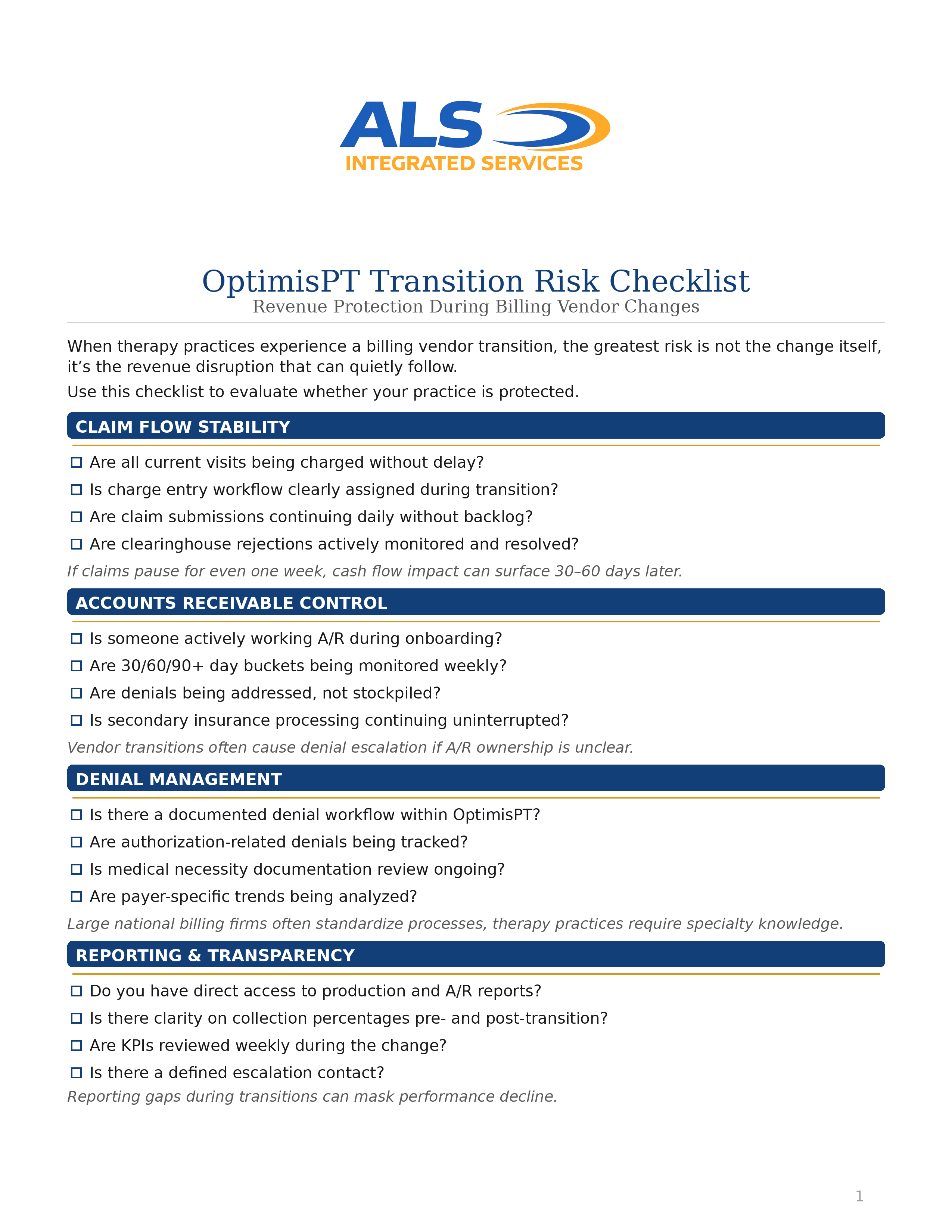
The ALS Integrated Services Approach
We don't just "submit claims." We manage your entire revenue cycle to ensure that "Payer Purgatory" doesn't become the graveyard for your clinic’s profits. We work as your partners, providing the peace of mind that comes with knowing every dollar you’ve earned is being tracked and collected.
If you are seeing high volumes but your bank account is stagnant, it is time for a professional review of your A/R. We offer a confidential review of your revenue cycle oversight to identify exactly where your cash is getting stuck.
Frequently Asked Questions
Why does my software say "Accepted" but the insurance company says they don't have the claim?
This usually means there is a "clearinghouse rejection." The claim passed your software's check and reached the clearinghouse, but the clearinghouse couldn't pass it to the payer. Your team must check the "Rejected" or "Error" reports daily to catch these.
How do I handle high-deductible plans at the beginning of the year?
The best approach is transparency. Inform patients before their appointment what their estimated responsibility will be. Collect a portion of that deductible at the time of service. It is much harder to collect $200 from a patient three months after their visit than it is while they are in your office.
What is the average "Days in A/R" for a healthy therapy clinic?
Ideally, you want your Days in A/R to be under 35. If you are pushing 45 or 50 days, you likely have a significant "Payer Purgatory" problem that needs immediate attention.
Should I hire an in-house biller or an RCM service?
It depends on your volume. However, many in-house billers are overwhelmed by front-desk duties and "firefighting." A dedicated RCM partner like ALS Integrated Services, LLC provides a layer of accountability and specialized expertise that is hard to replicate in-house.
Don't Let Your Revenue Sit in Limbo
Your clinic provides essential services. You deserve to be paid for every minute of care you provide. If you’re tired of seeing "claims sent" but not "money received," let's talk. We can help you build a reliable, streamlined system that gets you out of the "submit and pray" cycle and into a predictable cash flow.

Ready to fix your cash flow?
Contact Amy L. Smith and the team at ALS Integrated Services, LLC today.
Phone: 844.257.7820
Web: alsintegratedsvc.com
Explore more: Visit our Insights page for more tips on medical billing and clinic management.