Meta Description: Stop the revenue leak! Learn why credentialing delays happen and how to streamline clinic operations to get your new providers paid faster and protect your cash flow.
You finally found them. After months of searching, interviewing, and negotiating, you’ve hired a stellar physical therapist to join your team. They have the manual skills, the bedside manner, and the work ethic your clinic needs. They start on Monday, their schedule is already filling up, and you’re breathing a sigh of relief.
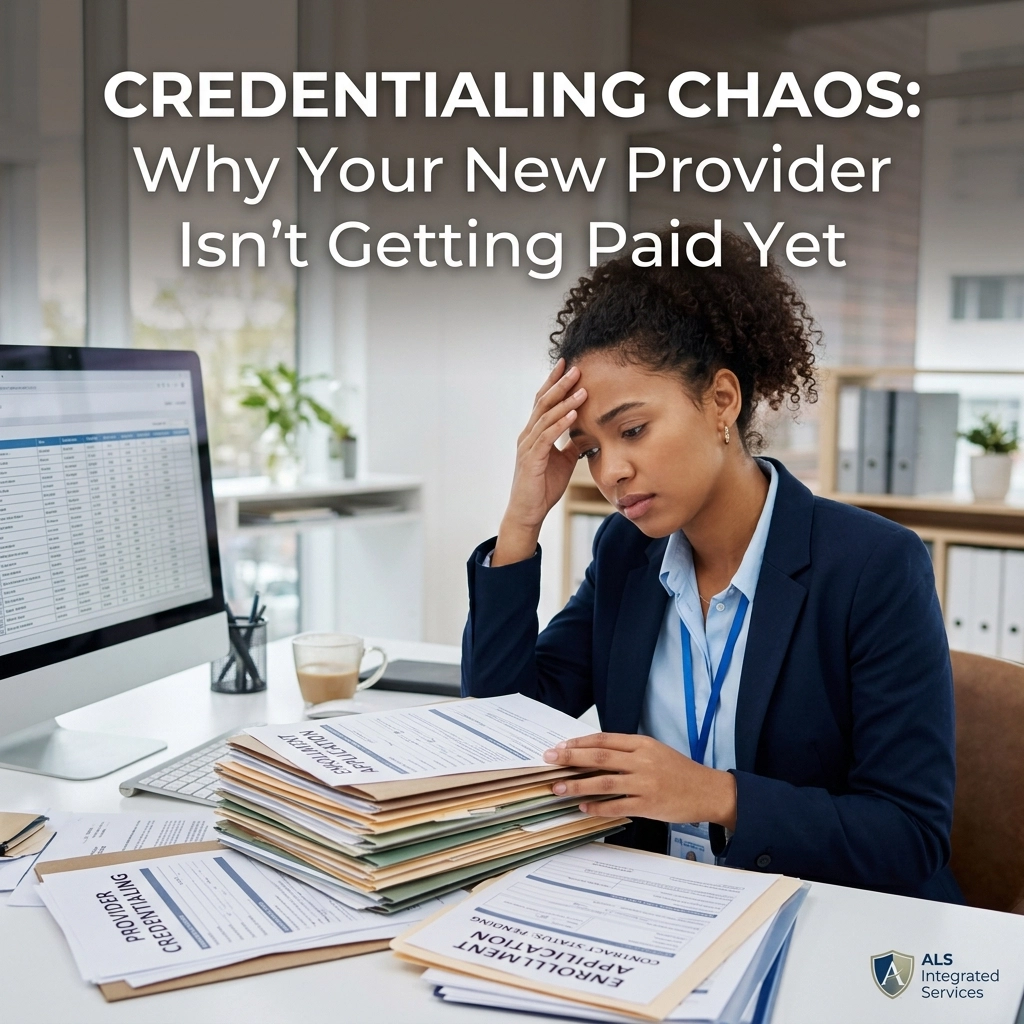
But then, the reality of the revenue cycle hits. Three weeks in, your billing team drops the bomb: none of the claims for the new provider can be submitted yet. The credentialing hasn’t cleared. In fact, it might not clear for another 60 to 90 days.
Suddenly, your "new hire win" feels like a massive financial liability. This is what we call credentialing chaos, and it is one of the most common reasons why therapy practices see their cash flow grind to a halt. To successfully streamline clinic operations, you have to treat credentialing not as a post-hire administrative task, but as a critical component of your recruitment and onboarding strategy.
The High Cost of the "Wait and See" Approach
Many clinic owners view credentialing as a box to tick once the provider is in the building. In reality, every day a provider sees patients without being credentialed is a day of lost or deferred revenue.
Let’s look at the math. If a single therapist sees 20 patients a week with an average reimbursement of $125 per visit, that’s $2,500 in weekly revenue. If the credentialing process lags for 60 days (a standard timeframe for many commercial payers), you are looking at $20,000 in stalled revenue. If it stretches to 120 days, which is increasingly common with payers like UnitedHealthcare or Cigna, that’s $40,000 hanging in the balance for just one provider.
When you factor in the beginning-of-year deductible resets, the situation gets even tighter. At the start of each year, patients are often responsible for their full bill until they hit their high deductibles. If your provider isn't credentialed, you can't even accurately tell the patient what they owe as an in-network provider, leading to "surprises" that damage patient trust and make collections nearly impossible later on.

Why the Delay? The Anatomy of Credentialing Chaos
If credentialing is so vital, why does it always seem to go wrong? Based on our years of experience at ALS Integrated Services, the chaos usually stems from three specific areas:
1. The CAQH "Black Hole"
CAQH (Council for Affordable Quality Healthcare) is the industry standard, but it’s also where many applications go to die. Providers often forget that a CAQH profile must be re-attested every 120 days. If your new hire hasn’t looked at their profile since their last job, it’s likely "stale." Payers won't even look at an application if the CAQH data isn't current, attested, and complete with updated copies of licenses and malpractice insurance.
2. Incomplete or Inaccurate Data
A single typo can cost you three months. We’ve seen applications rejected because a provider’s name on their CAQH didn't perfectly match their NPI registry or their state license. For clinics in Pennsylvania (PA) or Colorado (CO), where state-specific licensure boards can sometimes have their own backlogs, ensuring data parity across all platforms is non-negotiable.
3. Payer Processing Lag and Lack of Follow-up
Insurance companies are not in a hurry to add more providers to their networks. They are perfectly content to let an application sit in a "pending" queue for months. Without a dedicated team to call, poke, and prod the payer representatives, your application will simply collect digital dust.
The State-Specific Hurdle: AZ, PA, and CO Insights
Credentialing isn't a "one-size-fits-all" national process. Depending on where your clinic is located, you may face different hurdles:
- Arizona (AZ): Arizona has seen a surge in population, leading to many new clinics opening. This has caused some payers in the Phoenix and Tucson areas to claim "network adequacy," meaning they may try to deny new provider enrollments because they believe they have enough therapists in the area. You need a strategy to prove your clinic provides a unique or necessary service to bypass these blocks.
- Pennsylvania (PA): PA payers can be notoriously slow with CAQH pulls. Furthermore, ensuring that your providers are correctly linked to your Group NPI and Tax ID is a step that often gets botched in the transition between different health systems.
- Colorado (CO): With a high volume of independent and specialized practices, Colorado payers often require very specific documentation regarding "supervising" vs. "performing" providers, especially for Medicaid (Health First Colorado) enrollments.
How to Streamline Your Credentialing Workflow
To avoid the "credentialing chaos," you need to move the process to the beginning of your hiring funnel. Here are the practical steps we recommend to our clients:
Start 90 Days Before the Start Date
The moment a candidate signs an offer letter, credentialing should begin. Do not wait for their first day in the clinic. At ALS Integrated Services, we often tell owners that the "onboarding" starts the minute the contract is inked.
Use a "Ready to Enroll" Checklist
Before you submit a single form, ensure you have:
- A fully attested and updated CAQH profile.
- Current Malpractice Insurance (COI) with the new clinic listed (or a binder for it).
- Correct NPI 1 and NPI 2 information.
- State-specific Medicaid numbers (if applicable).
- Current resume/CV with gaps longer than 6 months explained.
Align with Your Billing Team
One of the biggest mistakes is a lack of communication between the person doing the credentialing and the person doing the billing. If the billing team doesn't know exactly when a provider is officially "par" (participating), they might accidentally submit claims too early. These claims will be denied as "Provider Not Credentialed," and once a claim is denied for that reason, it can be a nightmare to get it reprocessed correctly even after the credentialing is finalized.
Our guide to therapy billing simplified highlights the importance of documentation and timing in the revenue cycle.
The Medicare Factor: GP, GO, and GN Modifiers
For physical therapy clinics, Medicare credentialing is its own beast. You must ensure your provider is not only enrolled in PECOS but also correctly assigned to your group. Missing the "effective date" by even one day means you cannot bill for those services.
Remember, for Medicare billing, using the correct modifiers is essential once the provider is active. Whether it's GP (Physical Therapy), GO (Occupational Therapy), or GN (Speech-Language Pathology), your billing system must be ready to deploy these modifiers the second the credentialing is green-lit. This is a core part of our medical billing services for physical therapy clinics.
Managing the Cash Flow Gap
If you find yourself in the middle of credentialing chaos, where the provider has started but the payers aren't paying, you have to be proactive about your cash flow.
- Prioritize Patient Collections: Since you can't bill the insurance yet, ensure your front desk is trained to collect copays and estimated deductibles upfront. Our insights on eligibility verification mistakes can help your team avoid common errors during this sensitive period.
- Monitor A/R Weekly: Keep a "Credentialing Hold" bucket in your accounts receivable. Know exactly how much money is sitting there so you aren't surprised when your bank balance doesn't match your productivity reports.
- Credentialing as an RCM Metric: Treat credentialing status as a key performance indicator (KPI). It isn't just "HR work", it is revenue cycle management.
Don't Let Credentialing Kill Your Momentum
Hiring a new provider should be a time of growth and excitement, not a period of financial stress and "Payer Purgatory." By understanding the timelines and the common pitfalls, you can protect your clinic from the "black hole" of stalled claims.
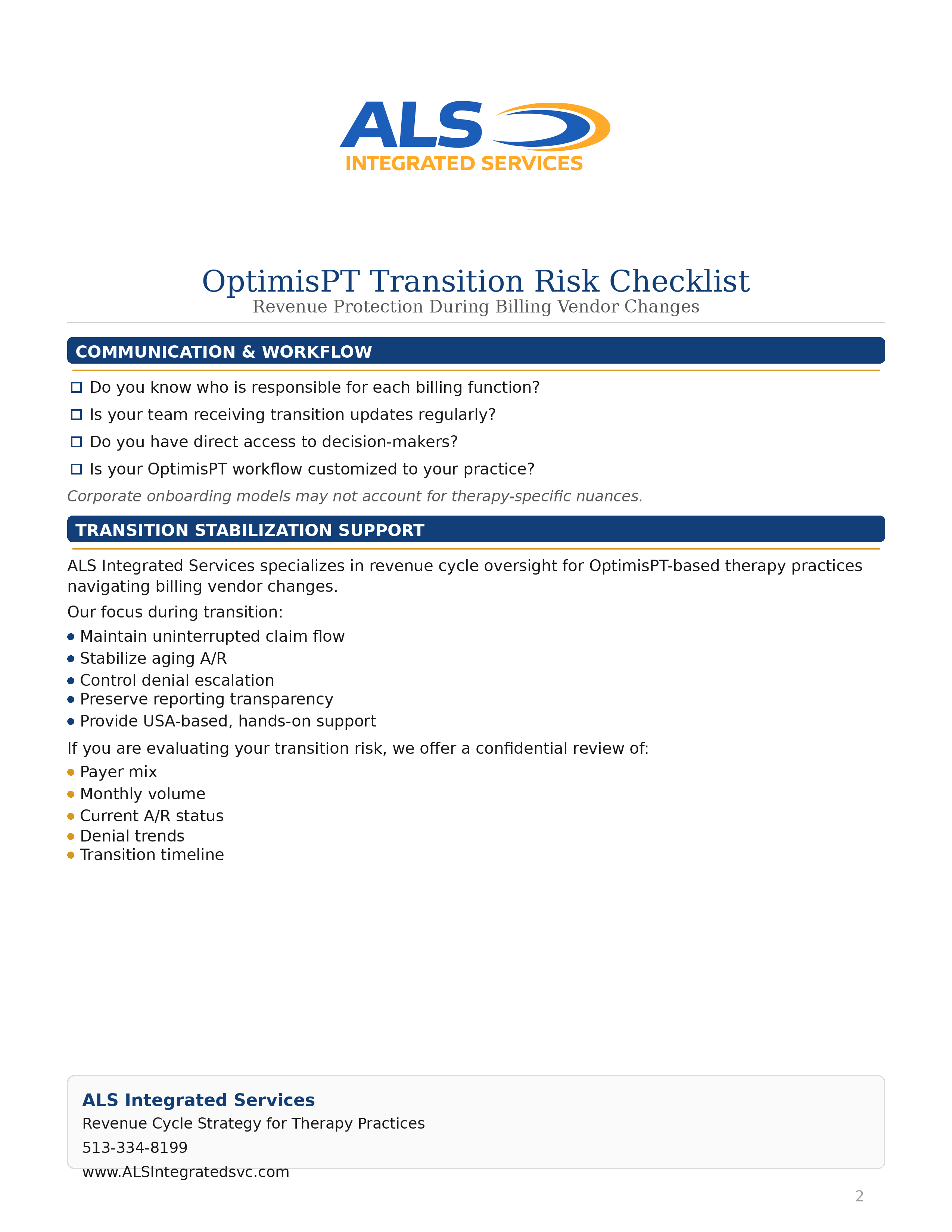
At ALS Integrated Services, we specialize in helping therapy practices navigate these administrative hurdles. Whether you are wondering if you really need in-house therapy billing or you need an expert team to handle the "Confessions of a Medical Biller" style leaks in your practice, we are here to help.
Don't let your new provider work for free. Let's get your credentialing under control and your revenue flowing.
Ready to stop the chaos? Contact ALS Integrated Services today for a consultation on how we can manage your billing and credentialing so you can focus on what you do best: treating patients.
FAQ: Provider Credentialing
How long does credentialing usually take?
Typically 60 to 120 days, depending on the payer and the state (AZ, PA, and CO have varying timelines).
Can we bill for a provider before they are credentialed?
Generally, no. Submitting claims for an uncredentialed provider as if they were another provider (using a different NPI) is considered fraudulent. In some cases, you may be able to see patients as "out-of-network," but this must be communicated clearly to the patient.
What is CAQH?
CAQH is a central database used by most commercial insurance payers to verify a provider's credentials. Keeping it updated is the #1 way to speed up your enrollment.
How does credentialing affect my cash flow?
It creates a "lag" where you are paying a provider's salary and clinic overhead but cannot collect the corresponding insurance revenue for 2–4 months. Proper planning is required to weather this gap.