

I remember the look on the clinic owner’s face when I showed him the spreadsheet. Let’s call him Dr. Miller. He ran a thriving physical therapy practice in Scottsdale, Arizona. His waiting room was always full, his therapists were burnout-level busy, and his clinical outcomes were top-tier. But his bank account? It was leaking.
He didn't have a "catastrophic" failure. He didn't have a massive lawsuit or a building fire. He had something much more dangerous because it was invisible: a slow, steady drip of denied claims and uncollected patient balances. By the time he called us at ALS Integrated Services, that drip had turned into a $50,000 annual leak.
If you’re running a practice, you might think your physical therapy billing is "fine" because the checks are still coming in. But in my years as a medical biller, I’ve learned that "fine" is often the most expensive word in healthcare.
In this installment of Confessions of a Medical Biller, I’m pulling back the curtain on how tiny coding errors, the kind that seem like nitpicking, can drain your revenue, and how you can plug those holes before another quarter goes by.
The Devil in the Details: The Modifier Trap
The most common way I see PT practices lose money isn't through fraud or gross negligence; it’s through the "Always Therapy" modifiers. You know the ones: GP (Physical Therapy), GO (Occupational Therapy), and GN (Speech-Language Pathology).
To a therapist, these modifiers feel like a redundant bureaucratic hoop. "Of course it’s physical therapy," they tell me. "I’m a physical therapist!"
But to a payer, a claim without a GP modifier is a gift. It’s a reason to auto-deny the claim without a human ever looking at it. In Dr. Miller’s case, his new staff member thought the software was "handling it." It wasn't. Over six months, hundreds of claims were kicked back. Because no one was aggressively managing the denials, those claims sat in "Payer Purgatory" until they hit the timely filing limit.
That was the first $12,000 of his leak.
When you outsource PT billing to experts who live and breathe these codes, we catch those missing modifiers before the claim ever leaves the "clearinghouse." Our complete guide to medical billing for physical therapy practices explains exactly how these coding standards protect your cash flow.

The "Beginning of the Year" Deductible Ghost
We are currently in late March. For many practices in states like Pennsylvania and Colorado, this is the "danger zone." Why? Because of the New Year deductible reset.
From January through March, many patients are walking around with $3,000 or $5,000 deductibles they haven't met yet. If your front desk isn't verifying benefits every single time a patient walks in during Q1, you are essentially providing free care.
I’ve seen clinics in Denver wait until the EOB arrives six weeks later to realize the patient owed the full $150 for the session. By then, the patient has finished their plan of care, and good luck collecting that money once they’ve stopped coming through your front door.
The Fix: You must have a "Credit Card on File" policy or a "Payment at Time of Service" requirement for high-deductible plans. If you aren't talking about money at the front desk, you’re losing money in the back office.
State-Specific Nuances: Why Geography Matters in Billing
One mistake I see clinic owners make is assuming a "national" billing company understands their local landscape. At ALS Integrated Services, we know that billing in Phoenix isn't the same as billing in Philadelphia.
Arizona (AZ)
In Arizona, we deal with a massive influx of Medicare Advantage plans. These plans are notorious for requiring prior authorizations that "expire" mid-treatment. If your billing team isn't tracking the visit count against the auth, you’ll find yourself with 5 visits that are medically necessary but financially unbillable.
Pennsylvania (PA)
Pennsylvania has some of the most complex Workers' Compensation regulations in the country. The fee schedules are specific, and if you aren't using the correct regional modifiers, your "clean claim rate" will plummet. We often see PA clinics under-coding because they are afraid of audits, leaving thousands on the table.
Colorado (CO)
Colorado is a leader in direct access, but that doesn't mean payers make it easy. We see a lot of "silent denials" here, claims that aren't technically denied but are "pended" for medical records that the payer never actually requested. Without a biller who picks up the phone to poke the bear, those claims will sit forever.

The $15 Leak: The High Cost of Small Errors
It’s not just the big $200 evaluations that cause the $50,000 leak. It’s the $15 underpayments on 97110 (Therapeutic Exercise) or 97140 (Manual Therapy).
Payers change their fee schedules constantly. If your contract says you should be getting $32 per unit for a specific code, but the payer starts sending $27, would you notice? Most in-house billers are so busy just trying to get claims out the door that they don't have time to perform a "Forensic A/R Audit."
If you see 40 patients a day and lose $5 an hour due to miscalculated fee schedules or improper CCI (Correct Coding Initiative) edits, that’s $200 a day. Over a 250-day work year, that’s $50,000 exactly.
That is the "Ghost Claim" problem. Your billing looks productive, but your cash flow is empty. You can read more about the ghost claim problem and how to solve it here.

How We Plug the Leak at ALS Integrated Services
When Dr. Miller came to us, he was exhausted. He was staying until 8:00 PM trying to figure out why his "Days in A/R" was creeping up to 65 days (industry standard should be under 35).
Here is the framework we used to save his practice:
- The 90-Day Forensic Audit: We didn't just look at new claims; we went back 90 days to find every single underpayment and "soft denial" that was ignored.
- Front Desk Training: We taught his team how to use their software to flag high-deductible patients before they sat in the waiting room.
- Modifier Automation: We set up "scrubbing" rules so that any claim missing a GP or GO modifier was flagged and fixed before it was even submitted.
- The "No-Hiding" Report: We provided a weekly transparent report showing exactly what was billed, what was paid, and, most importantly, what was denied and why.
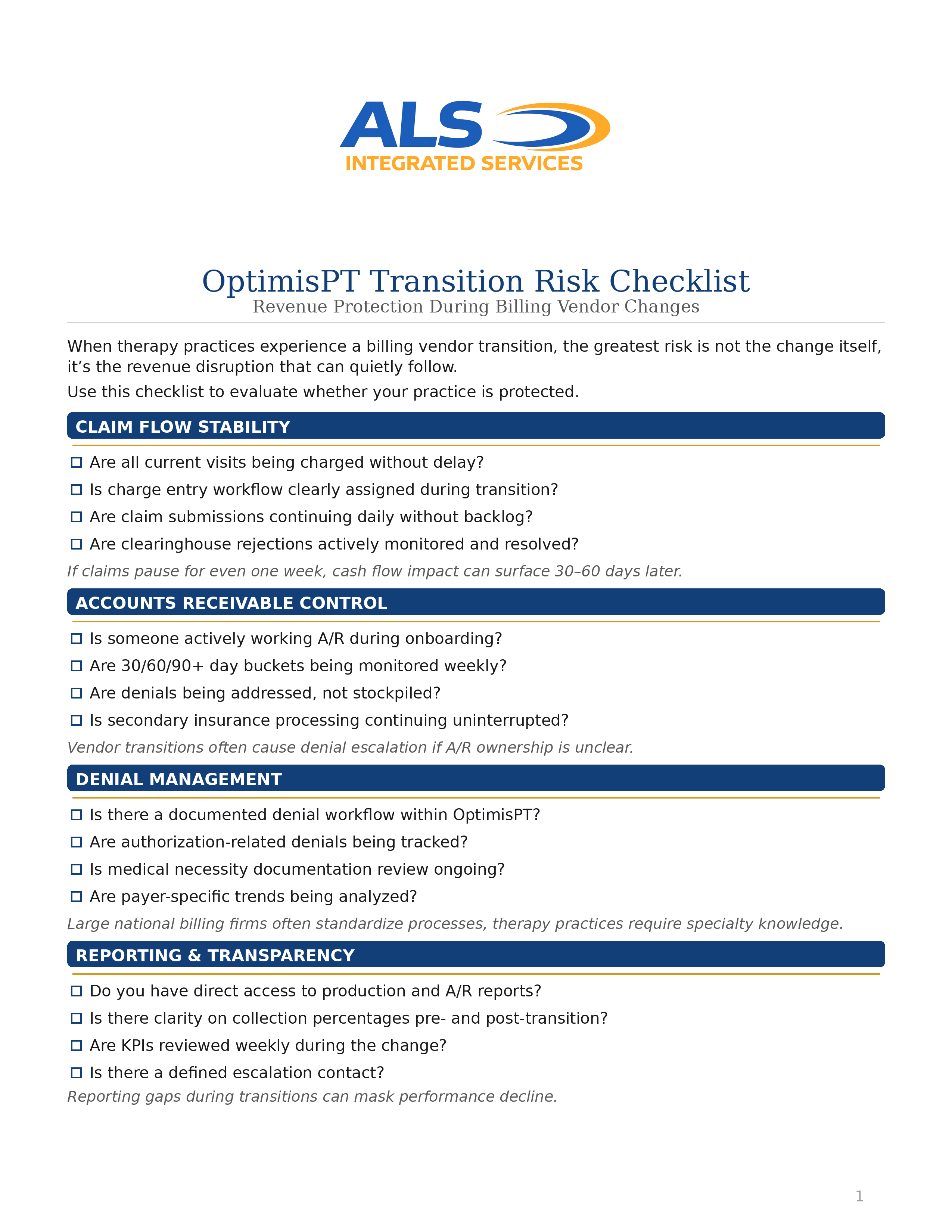
If you are worried about the stability of your revenue during a transition, our OptimisPT Transition Risk Checklist is a great place to start assessing your current vulnerabilities.
Is Your Practice Leaking? (A Quick Checklist)
Ask yourself these four questions. If you answer "no" or "I don't know" to any of them, you likely have a revenue leak.
- Do you know your "First Pass Clean Claim Rate"? (It should be 95% or higher).
- Are your therapists consistently using the GP/GO modifiers on all "Always Therapy" codes?
- Have you updated your patient's insurance info since January 1st to account for deductible resets?
- When was the last time you compared a random sample of Remittance Advices (RAs) against your actual contracted fee schedule?
Stop the Drip Today
The $50,000 leak doesn't happen all at once. It happens one missing modifier, one uncollected co-pay, and one ignored denial at a time.
At ALS Integrated Services, we don't just "process claims." We act as the financial guardians of your practice. Whether you are a small clinic in Pittsburgh or a multi-site operation in Denver, our goal is to ensure that every minute of care your therapists provide is a minute you get paid for.
Don't let your hard work disappear into the pockets of insurance companies who are counting on you being too busy to notice the errors.
Ready to plug the leak? Let’s talk about how our physical therapy billing services can stabilize your cash flow and give you back your evenings.
Contact ALS Integrated Services for a Revenue Consultation

Amy L. Smith
Owner, ALS Integrated Services
Frequently Asked Questions
Q: Why is my A/R higher at the beginning of the year?
A: This is usually due to the "Deductible Reset." Patients must pay out-of-pocket until their deductible is met, and if you aren't collecting at the time of service, your A/R will skyrocket while you wait for patient payments.
Q: What is the most common coding error in PT?
A: Missing modifiers (GP/GO/GN) and failing to follow the 8-minute rule for timed units. Both lead to immediate denials or significant underpayments.
Q: Should I outsource my PT billing or keep it in-house?
A: It depends on your volume, but many clinics find that the cost of an outsource PT billing partner is lower than the cost of the "revenue leaks" caused by an overwhelmed in-house staff. See our comparison guide here.