
Meta Description: Discover why choosing a physical therapy billing company in 2026 requires more than just claim submission. Learn how to optimize RCM and handle denials effectively.
As we move through 2026, the landscape of healthcare reimbursement has shifted dramatically. If you are a practice owner, you have likely asked yourself if you still need a partner for Medical Billing Services for Physical Therapy Clinics or if modern software can simply do it all for you. The answer is not as straightforward as it used to be. In the past, a billing company was often a "black box" where you sent your charges and hoped for a check. Today, the complexity of payer rules, the rise of value-based care, and the sheer volume of denials mean that a "traditional" transactional billing service is no longer enough.
The truth for 2026 is that you do not need a vendor; you need a strategic revenue partner. Whether you are looking to outsource PT billing for the first time or are reconsidering your current setup, understanding the new rules of the game is essential for your clinic’s survival.
The Financial Reality: In-House vs. Strategic Outsourcing
Many clinic owners in Pennsylvania, Colorado, and Arizona are feeling the squeeze of rising operational costs. When evaluating whether to keep billing in-house, you have to look beyond the surface level salary of a biller. In 2026, the cost of a skilled medical biller has climbed to between $55,000 and $75,000 annually, not including benefits, taxes, and the overhead of office space.
Furthermore, the technology stack required to stay compliant is more expensive than ever. When you factor in the 6 percent to 7 percent of collections that in-house billing typically costs, compared to the 5 percent to 8 percent for high-level therapy billing services, the gap narrows significantly. The real difference lies in the results. Many practices that transition to a professional partner see a 40 percent to 60 percent improvement in their cost-to-collect ratio because a specialized partner eliminates the "human error" and "turnover" variables that plague small clinics.

The 2026 Tech Trap: Why Software Isn't a Strategy
There is a common misconception that because EMR and billing software have become more "intelligent" with AI features, a dedicated billing team is less necessary. This is a dangerous line of thinking. While automation can speed up claim submission, it cannot effectively navigate a complex denial from a payer in Arizona or handle a nuanced audit in Pennsylvania.
In 2026, we see many "traditional" billing companies leaning too heavily on automation without human oversight. This leads to what we call the "Automation Gap." A computer might submit a claim perfectly, but if the payer changes a local coverage determination (LCD) overnight, the software will continue to submit failing claims until a human intervenes. At ALS Integrated Services, we believe that technology should augment humans, not replace them. Your billing partner should operate with "automation governance," ensuring that every automated step is monitored by a professional who understands the clinical side of physical therapy.
State-Specific Nuances: AZ, PA, and CO
Physical therapy billing is not a one-size-fits-all discipline. Different regions face unique challenges:
- Arizona (AZ): The payer mix in Arizona is increasingly dominated by managed care plans that require rigorous prior authorizations. A billing partner must be proactive in tracking these authorizations to prevent "no-auth" denials before the patient even walks through the door.
- Pennsylvania (PA): PA clinics often deal with a complex web of workers' compensation and commercial payers that have strict filing limits. Missing a window by even one day can result in a permanent loss of revenue.
- Colorado (CO): Colorado has been a leader in implementing value-based care initiatives. This requires your billing team to understand more than just CPT codes; they must understand how to report quality metrics and manage risk-adjustment data.
Confessions of a Medical Biller: The $50,000 Leak
In our recurring series, "Confessions of a Medical Biller," we recently encountered a clinic that thought their in-house team was doing a "decent" job. They had a steady stream of cash, but their days in A/R were slowly creeping up. After a confidential review, we discovered a $50,000 leak.
The culprit? A misunderstanding of the Medicare billing rules regarding the 8-minute rule and the improper use of the GP modifier. Because the in-house biller was also handling the front desk, they didn't have time to stay updated on the latest CMS updates. They were consistently under-coding certain sessions to "play it safe," effectively leaving tens of thousands of dollars on the table every year. This is why having a dedicated physical therapy billing company is an investment, not an expense. You can learn more about our approach to these issues on our services page.
The Early Year Hurdle: Deductibles and Cash Flow
One of the biggest threats to a clinic's stability is the beginning-of-year deductible reset. In 2026, high-deductible health plans are the norm. This means that in January, February, and March, your cash flow can drop significantly as patients become responsible for the full cost of their care.
To mitigate this, your billing partner should help you implement a "Point of Service" (POS) collection strategy. This includes:
- Verifying benefits at least 48 hours before the first appointment.
- Educating patients on their specific deductible and co-insurance responsibilities.
- Collecting estimated payments at the time of service rather than waiting for the EOB.
Clear patient communication is key. If your front desk team isn't trained to have these "money conversations," your A/R will balloon in the first quarter, creating a deficit that is hard to recover from.
PT-Specific Deep Dive: Codes and Modifiers
When you outsource PT billing, your partner must be fluent in the language of therapy. This includes a deep understanding of common CPT codes such as:
- 97110: Therapeutic Exercise
- 97112: Neuromuscular Re-education
- 97140: Manual Therapy
More importantly, they must correctly apply modifiers. The GP modifier (Physical Therapy), GO modifier (Occupational Therapy), and GN modifier (Speech-Language Pathology) are non-negotiable for Medicare and many commercial payers. In 2026, we are also seeing increased scrutiny on "bundled" payments and the $2,480 therapy threshold (KX modifier). A billing partner who doesn't live and breathe these rules is a liability. Our complete guide to physical therapy medical billing explains these nuances in even greater detail.

FAQ: Navigating the Choice in 2026
Q: Will I lose control of my data if I outsource?
A: Absolutely not. In fact, a modern partner like ALS Integrated Services provides more transparency than most in-house teams. You should have 24/7 access to your EMR and billing software, with real-time dashboards showing exactly where every dollar sits.
Q: Do I have to switch my software to work with you?
A: No. A "traditional" company might force you into their proprietary system. A strategic partner should be able to work within your existing workflow, provided the software meets modern security and API standards.
Q: How long does a transition take?
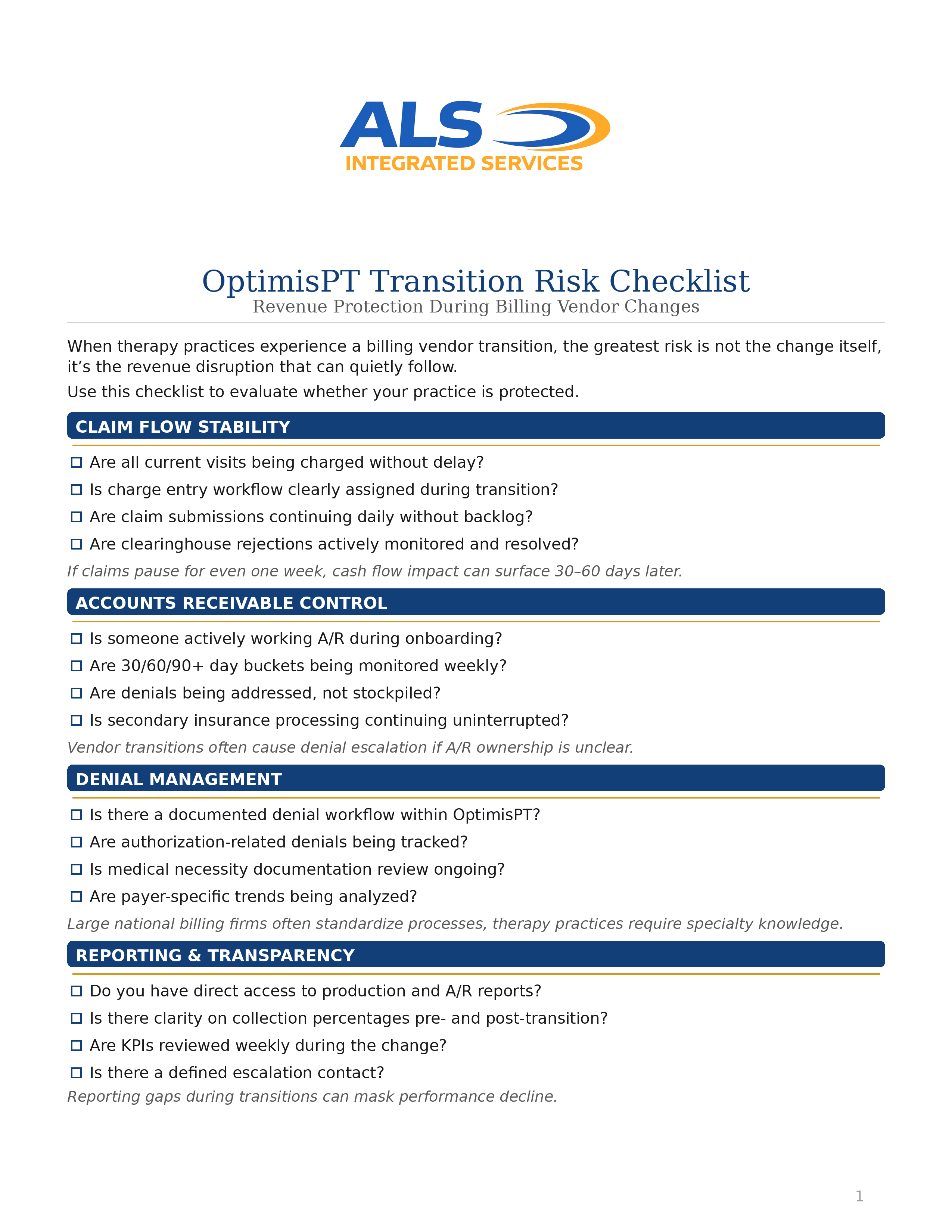
A: A well-managed transition typically takes 30 to 60 days. This includes credentialing verification, software integration, and workflow alignment. We provide a Transition Risk Checklist to ensure no revenue is lost during the switch.
Choosing Your Path Forward
The "truth" for 2026 is that the era of simple billing is over. The administrative burden on physical therapy clinics has never been higher, and the margin for error has never been thinner. Staying in-house is a viable option if you have a stable, highly trained team and the bandwidth to manage them. However, for most clinics, the specialized expertise of a partner like ALS Integrated Services provides the peace of mind and financial stability needed to focus on what matters most: patient care.
If you are seeing a rise in denials, a lag in cash flow, or simply feel like you are fighting the payers every single day, it might be time to move away from "traditional" billing and toward a more integrated approach.
Ready to see how your current billing stacks up? We offer confidential revenue cycle reviews to help you identify leaks and optimize your collections. Contact ALS Integrated Services today to start the conversation.