
You're doing everything right. Claims are going out the door on time. Your documentation is solid. Your codes are clean.
But your bank account? Still empty.
Here's the reality: submitting claims is only half the battle. The real money-maker is what happens after you hit "send", and most clinics don't have a system for it. They're hoping claims magically turn into deposits. Spoiler: they don't.
If you're constantly wondering "Did they pay us yet?" or discovering 90-day-old claims buried in your system, you need an A/R follow-up workflow that actually works. And no, you shouldn't have to work nights to make it happen.
Let's build one.
Why Claims Disappear Into the Black Hole
Before we fix the system, let's talk about why claims get stuck in the first place:
✔ Payers reject claims silently (no notification, just… nothing)
✔ Denial letters sit unopened for weeks
✔ Staff forgets to follow up at the right intervals
✔ No one owns the A/R process (everyone assumes someone else is handling it)
✔ You lack visibility into what's actually outstanding
The solution? A structured, repeatable follow-up system with clear touchpoints, accountability, and documentation.
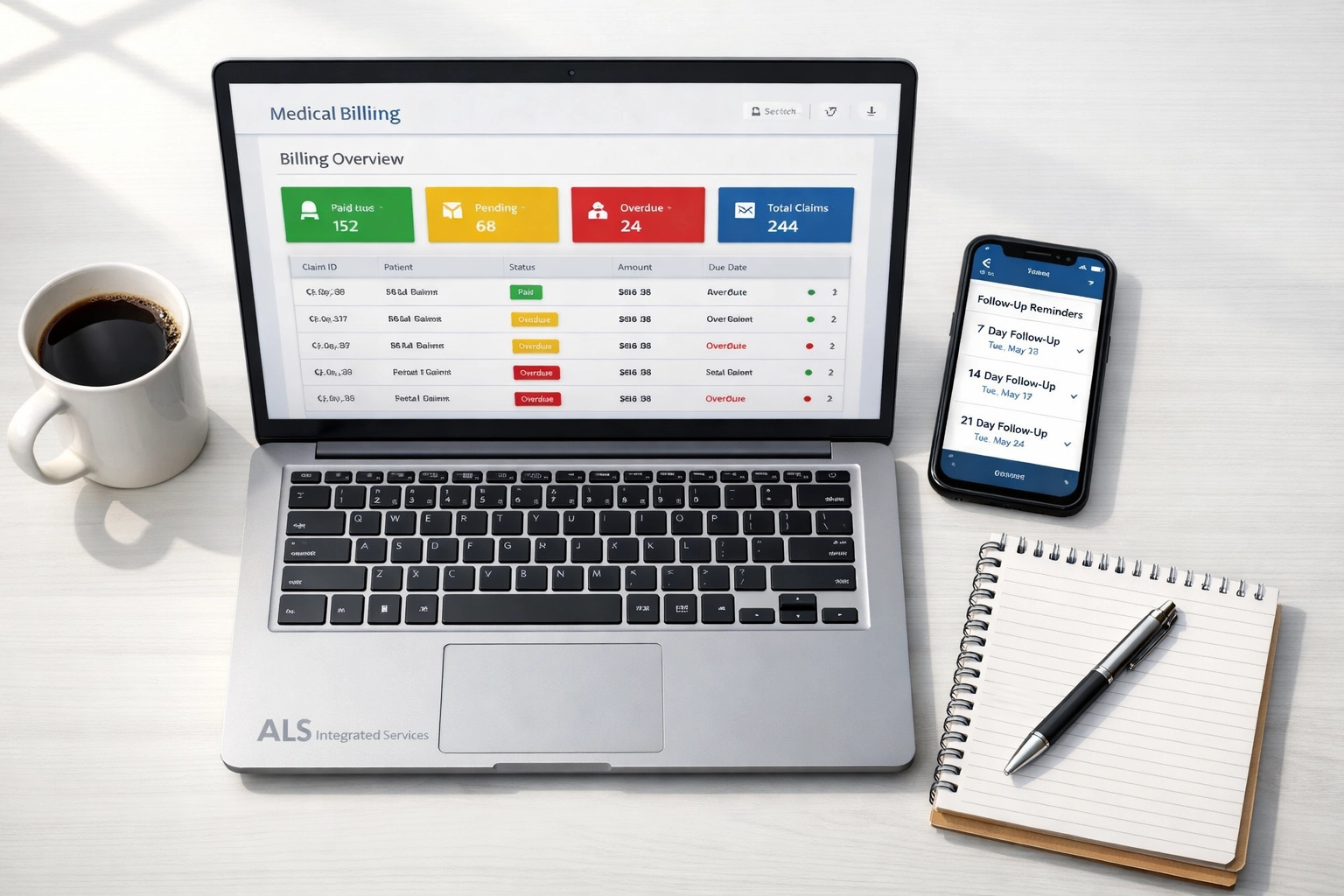
The A/R Follow-Up Framework: 7 / 14 / 21 Day Touchpoints
Your claims need a schedule. Think of it like dating, if you don't follow up, nothing happens.
Here's the rhythm that works:
Day 7: The First Check-In
Seven days after claim submission, run a claim submission QC audit:
✔ Confirm the claim was received by the payer (check payer portal or clearinghouse)
✔ Verify claim status isn't showing rejections or edits
✔ Flag any claims with "pending" status for manual review
✔ Document everything in your practice management system
Pro tip: Most clearinghouses will show you if a claim was rejected within 24–48 hours. If you're waiting seven days to check, you're already behind.
Day 14: The Payer Portal Deep Dive
Two weeks post-submission, it's time to dig deeper. Log into each payer portal and check:
✔ Payment status (processed, pending, denied?)
✔ Any requests for additional documentation
✔ Coordination of benefits issues
✔ Authorization or eligibility problems
This is where you catch the "soft denials", the ones that don't generate a formal letter but quietly kill your claim.
Day 21: The Phone Call
If you haven't seen movement by day 21, pick up the phone. Use a standardized call script:
"Hi, I'm calling from [Clinic Name] regarding claim [number] for patient [name], DOS [date]. Can you confirm the status and expected payment date?"
Document every call in your system:
✔ Who you spoke with
✔ Reference number
✔ What they said
✔ Next action required
✔ Follow-up date
Reality check: Most clinic staff hate making these calls. That's why they don't happen consistently, and why your A/R ages out.
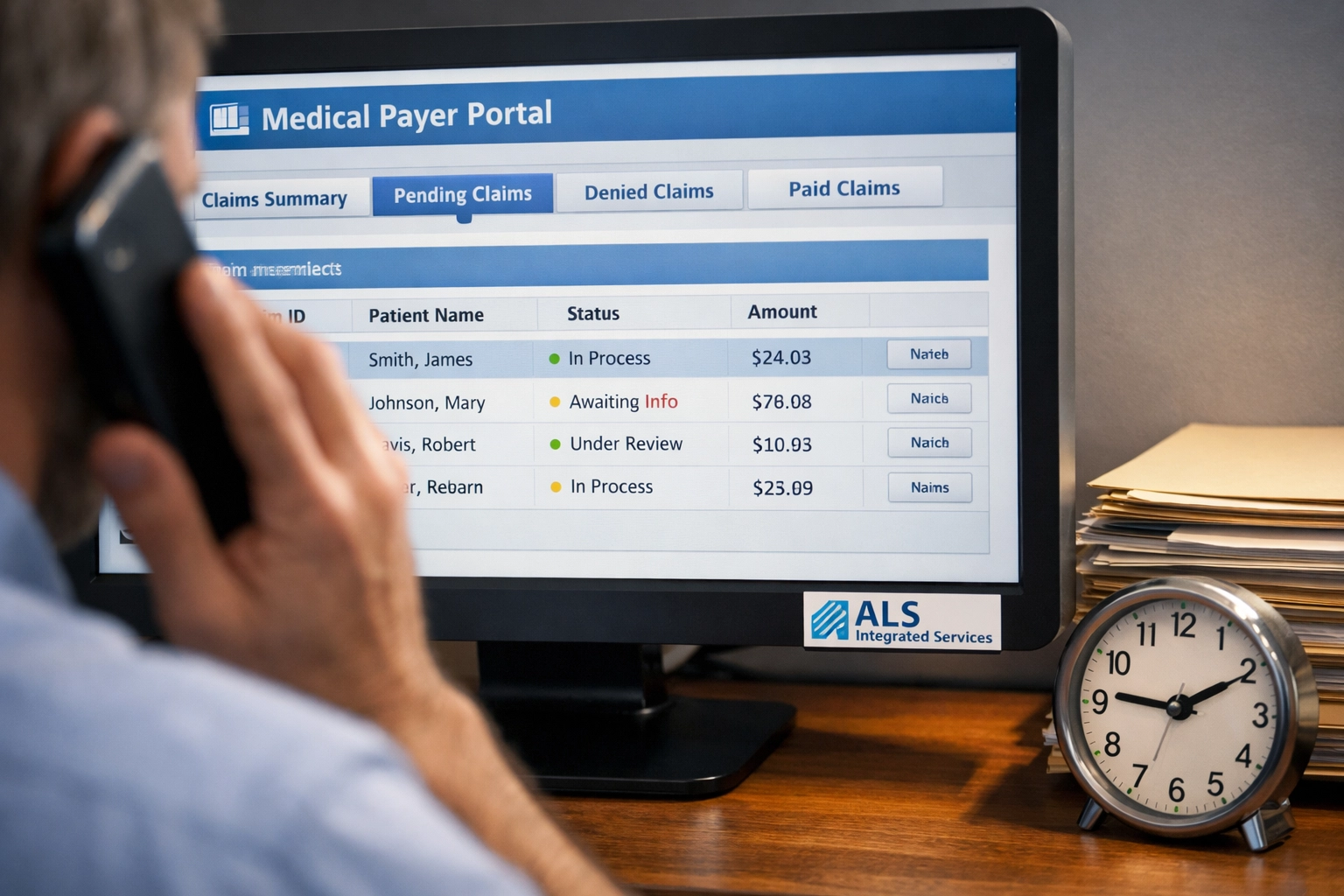
Denial Triage: Not All Denials Are Created Equal
When denials hit, you need a triage system to decide what's worth fighting for.
Priority 1: High-Dollar, Easy Fixes
Claims over $500 with simple denial reasons (missing modifier, wrong DOS, etc.). Fix and resubmit within 48 hours.
Priority 2: High-Dollar, Complex Issues
Claims over $500 requiring appeals, medical records, or peer-to-peer reviews. Assign to your most experienced biller and set a calendar reminder.
Priority 3: Low-Dollar Claims
Claims under $200. Be honest, sometimes it's not worth the time. Batch these for monthly review and decide if they're worth pursuing.
Priority 4: Write-Offs
Timely filing missed, patient deceased, payer out of business. Document and move on.
Key insight: Spending three hours fighting a $75 claim isn't smart business. Focus your energy where it moves the needle.
Documentation Templates That Save Your Sanity
You can't manage what you don't measure, and you can't prove you followed up without documentation.
Create templates for:
✔ Payer call log (date, time, rep name, claim number, notes, next step)
✔ Appeal letters (standardized language for common denial reasons)
✔ Patient statements (clear balance breakdown with payment options)
✔ Payment plan agreements (terms, schedule, signature line)
Store these in a shared drive so anyone on your team can execute the follow-up process consistently.

Patient Statements and Payment Plans: The Other Half of A/R
Payer denials aren't your only cash-flow problem. Patient balances are.
Workflow Branch: Jan/Feb Deductible Reset (Don’t Let It Wreck Your Cash Flow)
In January and February, your A/R system needs a specific branch for deductible resets. This is where claims may process correctly and still produce bigger patient balances than expected.
Add these steps to your front-end + A/R workflow:
✔ Eligibility check with a “deductible remaining” focus (before the visit)
- Confirm deductible amount + deductible remaining (not just “active coverage”)
- Verify coinsurance and patient responsibility basics
- Note plan type (HMO/PPO), referral rules, and any visit limits
- Document the result in the patient’s account so billing + front desk see the same info
✔ Front desk scripting for deductible responsibility (set expectations early)
- Explain that benefits reset and the patient may owe more until the deductible is met
- Confirm whether they want to pay today or set up a plan
✔ Same-day collection or payment plan (choose one, every time)
- Collect an estimated amount at check-in/check-out when appropriate
- If they can’t pay in full, set a payment plan that day (preferably with autopay)
✔ Separate tracking for patient balances created by deductible resets
- Flag these accounts (e.g., “DED RESET Jan/Feb”)
- Track: amount owed, statement dates, call attempts, payment plan status
- This prevents deductible-related balances from getting lost in insurance A/R worklists
✔ Send the first statement earlier (tighten timing in Jan/Feb)
Don’t wait for the balance to age. When deductible-driven balances post, start patient billing sooner so cash doesn’t stall.
Quick call script snippet (staff-friendly)
"Hi [Patient Name], this is [Staff Name] with [Clinic Name]. I’m calling because many plans reset deductibles in January, and your insurance is showing you have $[X] remaining on your deductible right now. That means today’s visit may apply to your deductible and your patient portion could be higher than usual. We can take a payment today, or we can set up a simple payment plan—what works best for you?"
Send Statements on a Schedule
Don't wait until the balance is 90 days old. Send statements:
✔ Day 1: After insurance processes (even if the balance is $10)
✔ Day 30: First reminder with "payment due" language
✔ Day 60: Second reminder with "please contact us to set up a payment plan"
✔ Day 90: Final notice before collections consideration
Offer Payment Plans Proactively
Patients want to pay: they just can't always do it in one lump sum. Offer plans upfront:
✔ 3-month plan for balances $300–$1,000
✔ 6-month plan for balances over $1,000
✔ Auto-pay options to reduce missed payments
Pro tip: Patients on payment plans are far less likely to dispute the bill or ignore your calls.
The KPI Dashboard You Actually Need
You can't fix what you can't see. Track these three metrics weekly:
1. Days in A/R
Goal: Under 30 days
Formula: (Total A/R ÷ Average Daily Charges)
If your days in A/R are creeping over 40, you have a follow-up problem: not a payer problem.
2. Denial Rate
Goal: Under 5%
Formula: (Denied Claims ÷ Total Claims Submitted) × 100
If denials are above 5%, you need to audit your front-end processes (eligibility verification, authorization, coding).
3. Clean Claim Rate
Goal: Over 95%
Formula: (Claims Paid on First Submission ÷ Total Claims) × 100
This tells you if your claims are going out "clean" or if you're creating your own A/R backlog with sloppy submissions.

How ALS Integrated Services Plugs the Leaks
Here's the truth: most clinics don't have time to build and maintain this system. You're busy seeing patients, managing staff, and keeping the lights on.
That's exactly where we come in.
Transparent A/R Reporting
We don't hide the numbers. You get real-time dashboards showing:
✔ Exactly what's outstanding
✔ Who owes what
✔ What we're doing about it
✔ When you can expect payment
No surprises. No excuses.
Proactive Denial Management
Our team doesn't wait for denials to pile up. We:
✔ Check claim status at 7, 14, and 21 days automatically
✔ Triage denials and prioritize high-value claims
✔ Appeal with documentation the first time (no back-and-forth)
✔ Work payer portals daily so nothing falls through the cracks
Patient Balance Collection That Works
We handle patient statements, payment plans, and follow-up calls with empathy and professionalism: so you don't have to chase your patients for money.

100% US-Based Team
Every person touching your A/R is based in the United States, understands HIPAA, and knows how to navigate payer policies. No offshore handoffs. No language barriers. No risk.
Stop Hoping. Start Collecting.
Claims going out doesn't mean cash is coming in. Without a structured A/R follow-up system, you're leaving money on the table: and working nights trying to catch up.
You have two options:
Option 1: Build this system yourself. Hire staff. Train them. Monitor compliance. Fix mistakes.
Option 2: Partner with a team that already has the system, the staff, and the track record.
Ready to stop the cash-flow leak? Contact ALS Integrated Services today and let's get your A/R under control: without you working another night.
ALS Integrated Services, LLC
Your partner in sustainable, predictable cash flow.
📞 Let's talk: Visit our website