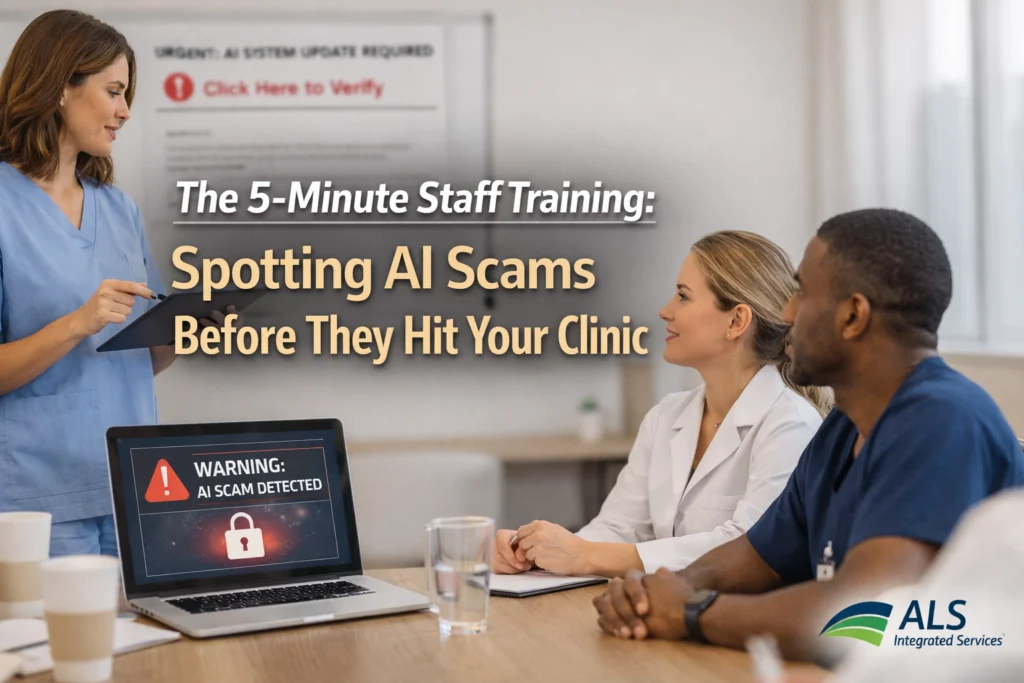
Meta Description: Learn quick medical front desk training tips to spot AI scams like deepfakes and phishing. Protect your clinic and streamline clinic operations today.
In the world of physical therapy and healthcare management, we often talk about efficiency in terms of patient throughput or billing cycles. But in 2026, the biggest threat to your productivity isn't a slow EMR, it's a high-tech scammer. Effective medical front desk training now requires more than just teaching staff how to verify insurance; it requires teaching them how to spot AI-generated fraud before it wreaks havoc on your practice.
If you want to streamline clinic operations, you have to protect your digital front door. A single clicked link or one "urgent" wire transfer based on a fake voice note can freeze your cash flow for weeks. The good news? You don't need a degree in cybersecurity to protect your clinic. You just need five minutes of focused training for your team.
Why AI Scams are Different (and Dangerous)
Gone are the days of the "Nigerian Prince" emails filled with typos and broken English. Today’s scammers use Large Language Models (LLMs) to write perfect, professional emails and deepfake technology to clone voices and even faces.
For a busy clinic in Arizona or Pennsylvania, where the front desk is juggling three lines and a waiting room full of patients, these scams are designed to exploit "decision fatigue." When we are busy, we are more likely to click first and ask questions later. That is exactly what these attackers are counting on.
The "Is This You?" Social Media Trap
One of the most common scams currently circulating involves social media messaging. A staff member might receive a notification on the clinic’s Facebook or Instagram page, or even their personal account, that says, "Hey, I saw this video of you, is this you??" followed by a link.
In the past, these were easy to spot. Today, the link often leads to a sophisticated, AI-generated clone of a login page (like Facebook, Microsoft 365, or even your EMR portal). Once the staff member enters their credentials to "see the video," the scammer has full access to your clinic's digital ecosystem.
The Training Tip: Teach your staff that any message asking "Is this you?" or "Look what they are saying about you!" is a 100% red flag. Never click the link. If they are curious, they should navigate to the site directly through their browser, not through the message link.
Deepfake Audio: When "The Boss" Calls
Imagine your front desk person receives a call. The voice sounds exactly like yours, Amy's voice, or the lead PT’s voice. The "boss" sounds stressed and says, "Hey, I’m at a conference in Colorado and I forgot to pay this vendor. Can you quickly process this $500 Zelle payment or give me the login for the corporate card? I need it right now before my session starts."
This is called "Voice Cloning," and it’s terrifyingly accurate. With just 30 seconds of audio from a YouTube video or a podcast, AI can replicate a person's voice perfectly.
The Training Tip: Establish a "Safe Word" or a callback protocol. If an "urgent" financial request comes in via phone or voice note, the staff member must hang up and call the person back on their known, internal office number. If it’s really you, you won’t mind the extra 30 seconds of security. This simple step is a cornerstone of the clinic owner's guide to streamlining operations without burning out.

Spotting the Fake Login Page
AI is now used to create "Pixel-Perfect" phishing pages. In the past, you could look for a blurry logo or a weird URL. Now, scammers can scrape your actual website and logo to create a mirror image of your patient portal or billing login.
In our experience at ALS Integrated Services, we’ve seen clinics targeted with fake "Payer Portal" updates. A staff member gets an email saying, "UnitedHealthcare has updated their provider portal. Please log in here to verify your 2026 NPI details." The link looks legitimate, the page looks legitimate, but the data is going straight to a hacker in another country.
The Training Tip:
- Check the URL: Look at the address bar. If it’s
u-n-i-t-e-d-healthcare.cominstead of the official domain, it’s a scam. - Browser Bookmarks: Tell your staff to only access high-stakes portals (like billing software or insurance sites) via saved bookmarks, never through links in an email.
The 5-Minute Staff Meeting Script
You can run this training in your next morning huddle. Here is a quick script to use:
- Acknowledge the Threat: "Team, AI is making scams look incredibly real. We are seeing fake voices and perfect-looking emails."
- The Golden Rule: "If a request involves money, passwords, or patient data, and it feels 'urgent,' that is our cue to slow down."
- The Verification Step: "Always verify the source. If I text you asking for a gift card or a login, call me on the office landline to check. I will never be mad at you for being safe."
- The Link Policy: "We do not click links in emails or social media messages that ask us to 'log in' or 'verify' accounts. We go directly to the website ourselves."
Investing this five minutes into medical front desk training can save you from the nightmare of a HIPAA breach or a drained operating account. Protecting your practice is just as important as the ultimate guide to therapy billing when it comes to long-term success.
Regional Insights: AZ, PA, and CO
Whether you are running a high-volume clinic in Phoenix, a multi-site practice in Philadelphia, or a boutique clinic in Denver, the risks are the same. However, we see specific trends in these states:
- Arizona: Scammers often target "Medical Tourism" or high-deductible plans common in the region, using AI to send fake "refund" requests to patients that actually harvest their credit card info.
- Pennsylvania: We’ve seen an uptick in fake "Credentialing Updates" that mimic state board communications.
- Colorado: Scams often focus on the transition to new telehealth regulations, sending fake "Compliance Checklists" that contain malware.
By staying vigilant, you ensure that your revenue cycle stays protected and your staff remains confident.

Confessions of a Medical Biller: The "Urgent" Payer Update
I remember a clinic owner who nearly lost $15,000 because an office manager thought they were being "helpful" by quickly clicking a link to update their "Direct Deposit" info for a major payer. The email looked exactly like a standard notice from Cigna. It was only because the owner had a policy that all banking changes had to be double-signed that they caught the scam. The "new" bank account on the form was a ghost account.
This is why having a partner who understands the operational side of billing is crucial. At ALS Integrated Services, we don't just process claims; we help you see the holes in your bucket before the water runs out.
Streamline Clinic Operations by Saying "No" to Scams
Efficiency isn't just about speed; it's about accuracy and security. When your team is trained to spot these AI threats, you reduce the "noise" and potential disasters that lead to burnout. A secure clinic is a streamlined clinic.
If you’re worried that your current billing setup or front-desk workflow is leaving you vulnerable, we should talk. From auditing your current revenue cycle to providing the oversight you need to sleep at night, we’re here to help.
Are you ready to take the headache out of your clinic operations?
Contact ALS Integrated Services today for a consultation on how we can simplify your billing and secure your practice’s future.
FAQ: AI Scams in Healthcare
What is the most common AI scam in 2026?
The most common is AI-enhanced phishing, where emails are written to perfectly mimic the tone and style of your specific vendors or colleagues, often leading to fake login pages.
How can I tell if a voice is a deepfake?
Listen for unusual prosody (the rhythm of speech), slight robotic glitches, or a lack of emotional nuance. However, the best defense is simply hanging up and calling the person back on a trusted number.
Does HIPAA cover AI scams?
If a staff member clicks a link and a hacker gains access to PHI (Protected Health Information), it is considered a reportable HIPAA breach. Training your staff to spot these scams is a key part of your HIPAA compliance plan.
Should we ban AI tools in the office?
Not necessarily. AI can be great for transcription or scheduling. The key is to have a strict policy about where AI is used and ensuring that no sensitive patient data is entered into unauthorized AI platforms.