In the rapid-fire world of 2026 healthcare technology, artificial intelligence is no longer a "future" concept, it is sitting right on your front desk. From automated scribes and AI-driven diagnostic tools to advanced chatbots handling patient inquiries, AI is streamlining operations in ways we couldn't imagine five years ago. However, this efficiency comes with a massive, often overlooked caveat: Your current HIPAA policy is likely silent on AI security.
At ALS Integrated Services, we’ve seen how a single vulnerability can cripple a clinic’s revenue cycle. Whether you are managing a physical therapy practice in Pennsylvania or a multi-specialty group in Arizona, the integration of AI requires more than just a software update; it requires a complete overhaul of your compliance framework. If your AI tools are handling protected health information (PHI), and your policy hasn't been updated since 2023, you aren't just at risk for a data breach, you are at risk for a total breakdown in your accounts receivable management healthcare workflows.
Why Your "Standard" HIPAA Policy Is Failing
Traditional HIPAA policies focus on encryption at rest, password complexity, and physical server security. While these remain vital, AI introduces unique "attack surfaces" that standard policies don't cover. AI models learn from data. If that data includes PHI and isn't properly "de-identified," that sensitive information can potentially be leaked through "model inversion" attacks or "prompt injection."
For clinic owners, the stakes are higher than ever. A breach doesn't just result in a fine from the OCR (Office for Civil Rights); it leads to a catastrophic pause in your medical billing services. When systems are compromised, claims stop moving, cash flow freezes, and your staff is left scrambling to manually reconstruct patient records while dealing with legal investigations.

The Financial and Legal Fallout: A High Price to Pay
We often talk about the "Ghost Claim" problem, where billing looks productive but the cash never arrives. An AI-related security breach is the ultimate ghost claim creator. If a breach occurs, your clinic faces:
- Civil Money Penalties: HIPAA violations in 2026 can reach millions of dollars depending on the level of "willful neglect."
- Reputational Damage: Patients in tight-knit communities, from Colorado Springs to Philadelphia, won't return to a clinic that leaked their private medical history to an AI bot.
- A/R Paralysis: During an investigation, your billing software may be taken offline. In an era where many clinics are already struggling with beginning-of-year deductible resets and high-deductible plans, a two-week shutdown can be the difference between staying open and filing for bankruptcy.
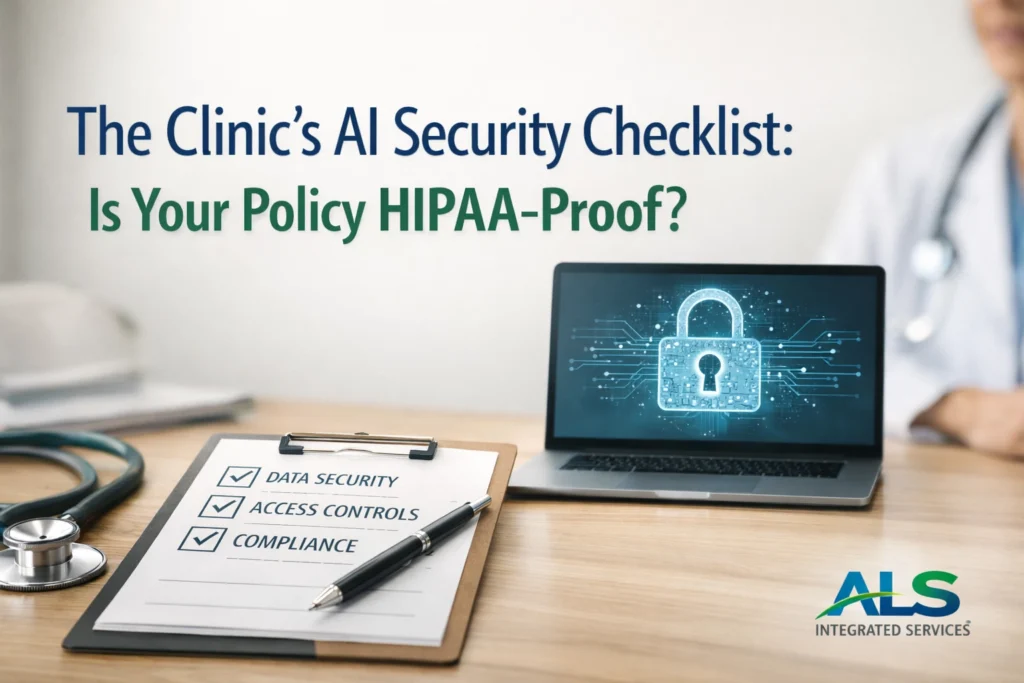
The Clinic’s AI Security Checklist
To ensure your practice remains HIPAA-proof, use the following checklist to evaluate your internal policies and your third-party AI vendors.
1. The Data Ingestion & Training Audit
- De-identification Protocols: Does your AI vendor confirm that PHI is stripped before the data is used to train their models?
- Encryption Standards: Is data encrypted at rest using AES-256 and in transit using TLS 1.2 or higher?
- Data Minimization: Are you only feeding the AI the specific data it needs to perform the task, or are you uploading entire patient charts?
2. Access and Authentication (The "Who" and "How")
- Multi-Factor Authentication (MFA): This is non-negotiable. Every system that touches AI-processed PHI must require MFA.
- Role-Based Access Control (RBAC): Does your front desk staff have the same AI permissions as your lead therapist? (Hint: They shouldn't).
- Session Timeouts: Does the AI interface automatically log out after 10 minutes of inactivity?
3. Monitoring and Incident Response
- Tamper-Resistant Logging: Your logs must record every interaction with the AI, including what was asked (the prompt) and what the AI responded.
- The 24-72 Hour Rule: While HIPAA allows for longer, your policy should mandate internal reporting of suspected AI "hallucinations" or leaks within 24 to 72 hours.
- Kill-Switch Procedures: Do you have a documented process to instantly disconnect the AI from your patient database if suspicious activity is detected?
4. Third-Party & Vendor Management
- The BAA Requirement: Do you have a signed Business Associate Agreement (BAA) specifically covering the AI's data usage?
- SOC 2 Type II/HITRUST: Does the vendor hold these certifications?
- Sub-processor Transparency: Who does your AI vendor use for cloud hosting? You need a list of every "sub-processor" that might see your data.
Connecting Compliance to Your Bottom Line
You might wonder why a medical billing company is so focused on AI security. The answer is simple: Security is the foundation of cash flow.
In our experience providing medical billing services for physical therapy clinics, we've seen that the most "profitable" clinics aren't just the ones with the most patients, they are the ones with the most stable operations. When your data is secure, your claims are clean. When your AI tools are HIPAA-proof, your staff can use them to speed up documentation without the fear of a looming audit.
As we move deeper into 2026, payers are becoming more aggressive in their audit tactics. They are looking for any reason to deny claims or recoup payments. An unsecure AI policy is an open invitation for a "payer purgatory" nightmare.
Practical Steps for Clinic Owners Today
If you’re feeling overwhelmed by the technicalities of AI security, start with these three steps this week:
- Inventory Your AI: Make a list of every tool your staff uses. Is someone using an unauthorized AI "note-taker"? Is the front desk using ChatGPT to draft patient emails? You can't secure what you don't know exists.
- Verify Your BAAs: Reach out to your software vendors and ask for their updated AI security whitepaper. If they can’t provide one, it’s a red flag.
- Staff Training: Conduct a 15-minute "AI Safety" huddle. Remind your team that they should never paste raw patient data into a public AI tool.
Effective accounts receivable management healthcare starts with preventing the disasters that stop payments in their tracks. By securing your AI pipeline, you aren't just "checking a box" for compliance; you are protecting the financial heartbeat of your practice.
How ALS Integrated Services Can Help
At ALS Integrated Services, we don't just "do the billing." We partner with clinics to ensure their entire revenue cycle, from front-desk data entry to final payment, is robust, compliant, and optimized for maximum reimbursement. Whether you are navigating the complexities of therapy billing vs in-house billing or trying to solve the ghost claim problem, we provide the expertise you need to stay focused on patient care.
Our complete guide to therapy billing covers more than just CPT codes; it covers the operational excellence required to thrive in today's digital landscape.
Don't let an AI scam or a weak security policy derail your 2026 goals. Let's make sure your clinic is protected from every angle.
Ready to stabilize your revenue and secure your operations? Contact ALS Integrated Services today for a consultation on how we can streamline your medical billing and compliance efforts.
Frequently Asked Questions
Is standard ChatGPT HIPAA compliant?
No. The free or standard "Plus" versions of ChatGPT do not come with a BAA and are not HIPAA compliant. Only specific enterprise-grade versions with a signed BAA can be used to process PHI.
Do I need a new BAA for every AI tool?
Yes. Any third-party vendor that "creates, receives, maintains, or transmits" PHI on your behalf must sign a Business Associate Agreement.
Can an AI breach affect my Medicare payments?
Absolutely. If your systems are compromised and you cannot verify the integrity of your records, Medicare and other payers may suspend payments until a full audit is completed.