Meta Description: Discover the proven denial management framework to beat AI-driven rejections in 2026. Learn how to streamline clinic operations and protect therapy revenue with ALS Integrated Services.
It’s April 21, 2026, and if you feel like your clinic is under attack by invisible robots, you aren’t paranoid, you’re observant. Welcome to the era of the "Algorithm War." While you’ve been busy providing life-changing therapy to your patients, insurance payers have upgraded their weaponry.
In 2026, denial management healthcare isn’t just about fixing mistakes; it’s about outsmarting artificial intelligence. Payers are now using sophisticated AI bots to auto-deny claims at record speeds, often for "errors" that a human wouldn't even flag. It feels like a classic David vs. Goliath situation for small clinics in Pennsylvania, Arizona, and Colorado. But here’s the secret: David had a better strategy.
At ALS Integrated Services, we’ve developed a framework to help you build a modern shield against these automated systems, allowing you to streamline clinic operations and keep your revenue where it belongs, in your practice.
The 'AI Bot' Problem: Why Your Claims Are Bouncing
Back in 2024, a "clean claim" rate of 95% was the gold standard. In 2026, that metric is almost meaningless. Why? Because of the "False Clean Claim."
Insurance companies are now using predictive logic to identify patterns in clinical documentation. If your note length for a specific CPT code (like 97110 or 97140) doesn't meet their AI’s expected "complexity threshold," the claim is rejected before it even hits a human adjuster's desk. They are looking for reasons to say "no" in milliseconds.
For therapy practices, this is particularly brutal. Whether you are dealing with Medicare in Philadelphia or private payers in Phoenix, the bots are looking for missing modifiers, mismatched diagnosis codes, and even subtle phrasing in your daily notes that suggests "maintenance" rather than "skilled care."

The Framework Part 1: Proactive Denial Identification (The "Shift Left" Strategy)
The old way of handling denials was reactive: wait for the Explanation of Benefits (EOB), see the rejection, and then try to fix it. In 2026, that’s a recipe for a cash flow heart attack.
To win, you must "Shift Left." This means moving your denial management healthcare efforts as far upstream as possible.
Don’t Wait for the EOB
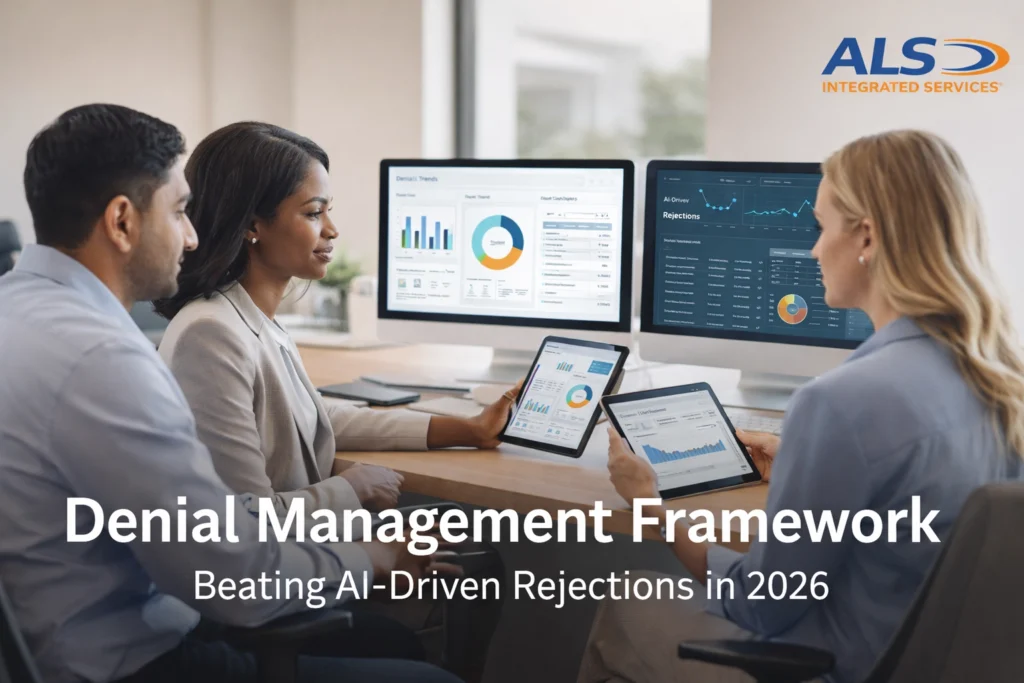
Use advanced dashboards to spot patterns before they become trends. At ALS, we help our clients identify "at-risk" claims before they are even submitted. Are your claims for a specific payer in Colorado suddenly taking 45 days instead of 14? That’s a signal.
Predictive Denial Scoring
We analyze your history to assign a "denial probability" score to claims. If a claim has a high probability of rejection: perhaps because it lacks a GP, GO, or GN modifier: it gets flagged for a human "AR Partner" to review. This prevents the "submit and pray" mentality that kills clinic efficiency.
The Framework Part 2: The Art of the Appeal
When a bot denies a claim, a bot-generated appeal will almost always fail. Why? Because the payer's AI is programmed to recognize and reject standard templates. This is where the human touch: the ALS way: beats the machine every time.
The Power of the Human Touch
In our experience, especially with complex therapy billing solutions, clinical documentation is your best weapon. When we appeal, we don't just send a form letter. We tell the story of the patient’s progress. We highlight the "skilled" nature of the intervention. We ensure that the GP (Physical Therapy), GO (Occupational Therapy), or GN (Speech-Language Pathology) modifiers are backed by robust, defensible documentation.
Navigating the 2026 Landscape
With the new 2026 CMS requirements, payers are now required to provide specific denial reasons and meet 7-day decision timeframes for prior authorizations. However, they often hide behind vague language. Our team knows how to cut through the jargon. The difference between a biller and an AR partner is the difference between someone who just clicks "resubmit" and someone who fights for your reimbursement.
The Framework Part 3: Loop Closing and Front Desk Synergy
Denials are often symptoms of a "front-end" problem. As we move through April, many clinics are still feeling the sting of beginning-of-year deductible resets. High-deductible plans are more common than ever in 2026, leading to slower payments and increased A/R aging.
Turning Denials into Training Opportunities
The third part of our framework is "Loop Closing." Every denial we fight becomes a data point for training your front desk.
- Is a specific payer in Arizona now requiring a new authorization format?
- Are we seeing a spike in "Member Not Eligible" denials because secondary insurance wasn't captured?
By feeding this information back to your administrative team, we help you streamline clinic operations. We turn your front desk into a proactive defense line. Instead of awkward conversations about "Why is my bill so high?", your team can have proactive discussions about deductibles and co-insurance, turning awkward conversations into collections.

Confessions of a Medical Biller: The Case of the "Invisible" Threshold
Last month, we worked with a clinic in Pennsylvania that was seeing a 30% increase in denials for therapy services exceeding the Medicare threshold. The clinic owner was pulling her hair out because her EMR said everything was fine.
When we audited their system, we realized their "automated" billing software was failing to track the combined PT/SLP threshold correctly. The AI at the insurance company saw the overage and auto-rejected every claim. It wasn't a "mistake" by the therapists; it was a failure of the technology to keep up with the rules. This is why your EMR's automatic billing service might be killing your revenue.
We stepped in, manually audited the units, corrected the modifiers, and successfully appealed over $40,000 in "dead" claims. That is the ALS shield in action.
Why ALS Integrated Services is Your Modern Shield
In 2026, you can't fight high-tech insurance bots with low-tech billing processes. You need a partner that understands the specific nuances of physical, occupational, and speech therapy.
We provide medical billing services that go beyond data entry. We offer:
- State-Specific Expertise: Whether it's navigating the intricacies of PA No-Fault laws or AZ workers' comp, we know the local landscape.
- Modern Visuals & Transparency: No more "black hole" billing. Our reporting gives you a clear view of your A/R at all times.
- Proactive Compliance: We keep you ahead of the ICD-10-CM Excludes1 rules and Medicare's ever-changing "Threshold" logic.

Conclusion: Don’t Let the Bots Win
The "Goliath" insurance companies want you to get frustrated. They want you to accept the 10% "leakage" in your revenue as the cost of doing business. But at ALS Integrated Services, we don't accept that. We believe that every therapist deserves to be paid for the incredible work they do.
By implementing a proactive, data-driven denial management framework, you can protect your practice from AI-driven rejections and focus on what you do best: healing patients.
Ready to Beat the Bots?
Don't wait for your A/R to hit the danger zone. Let’s take a look under the hood of your current billing process.
Schedule a 'Denial Audit' with ALS Integrated Services today.
We’ll show you exactly where the bots are winning and how we can help you take your revenue back.
FAQ: Denial Management in 2026
Q: What are the most common therapy modifiers used in 2026?
A: The core modifiers remain GP (Physical Therapy), GO (Occupational Therapy), and GN (Speech-Language Pathology). However, ensuring these are paired correctly with the 2026 CQ/CO assistant modifiers is crucial for avoiding auto-denials.
Q: How can I improve my clinic's front-desk collections?
A: Focus on verification of benefits before the first visit. With high-deductible plans becoming the norm, collecting the estimated patient portion at the time of service is the only way to maintain a healthy cash flow.
Q: Why is my "clean claim" rate high but my bank account low?
A: This is likely due to the "False Clean Claim" phenomenon mentioned above. Your software thinks the claim is fine, but the payer's AI is rejecting it post-submission for "lack of medical necessity" or "documentation inconsistencies." You need a deeper audit of your A/R.
