
Meta Description: Stop losing revenue to "automatic" EMR billing. Compare integrated vs. private therapy billing solutions to fix denials and boost your clinic's cash flow in 2026.
If you’re a clinic owner, you’ve heard the pitch a thousand times: "It’s a one-stop-shop! Our EMR handles the documentation and the billing automatically. Just click a button, and the money rolls in."
It sounds like a dream. In reality, for many physical therapy, occupational therapy, and speech-language pathology practices, that "automatic" button is more like a slow-drip leak in your bank account. While integrated medical billing services offer the allure of convenience, they often lack the surgical precision required to actually capture every dollar you’re owed.
At ALS Integrated Services, we’ve seen the "all-in-one" hangover firsthand. From botched data mapping to a total lack of denial follow-up, relying solely on your EMR’s built-in billing arm can be a recipe for financial stagnation. Here is why your "integrated" solution might be failing you, and why a private, specialized partner is the upgrade your revenue cycle deserves.
The Myth of the "One-Click" Revenue Cycle
The biggest selling point for EMR-integrated billing is simplicity. You document the note, the system "scrubs" the claim, and it flies off to the payer. But "automatic" is often a synonym for "inflexible."
EMR companies are, first and foremost, software developers. Their billing departments are frequently massive, high-volume call centers where your claims are just one of a million in a digital stack. When a claim hits a snag, say, a tricky Medicare rule in Pennsylvania or a specific payer quirk in Arizona: the "automatic" system doesn't have a conversation with you. It doesn't investigate. It simply marks the claim as "rejected" or, worse, lets it sit in a virtual purgatory.
The Problem with Data Mapping
Research shows that inaccurate data mapping is a primary culprit for revenue leakage. Every diagnosis code and procedure code must map perfectly from the clinical side to the billing module. When this fails: and it often does in "automatic" setups: claims go out with incomplete or mismatched data. This leads to the ghost claim problem, where your dashboard says you're productive, but your bank account remains empty.

Why Integrated Billing Services Often Leave Money on the Table
When you use the billing service attached to your software, you’re often getting a "claim submitter," not a "claim hunter." There is a massive difference.
1. Poor Denial Management
Integrated billing services are notorious for "low-touch" denial management. If a claim is denied, their goal is to process the next 10,000 easy claims rather than spending 45 minutes on the phone fighting for your single $150 reimbursement.
Data suggests that nearly 20% of all claims are denied or underpaid, and up to 60% of those are never resubmitted. A private billing specialist doesn't just look at the 80% that paid; they live in the 20% that didn't. We call this winning the denial war, and it’s where the real profit is found.
2. The Lack of Personalized Service
In a large EMR billing department, you are a ticket number. You don't have "your person" to call when you realize you've been using the wrong modifier for a new Colorado Medicaid contract.
With private therapy billing solutions, you get a partner who understands the nuances of your specific practice. Whether it’s handling the complexities of the GP (Physical Therapy) or GO (Occupational Therapy) modifiers or ensuring your Medicare 8-minute rule calculations are bulletproof, a private specialist provides the human oversight that software simply cannot replicate.
The PT-Specific Nuance: Why Generalists Fail
Physical therapy billing is its own animal. You aren't just billing a 99213 office visit. You’re dealing with:
- CPT Code Combinations: Managing 97110 (Therapeutic Exercise), 97140 (Manual Therapy), and 97112 (Neuromuscular Re-ed) in a way that maximizes reimbursement without triggering an audit.
- Medicare Rules: Navigating the therapist assistant modifiers (CQ/CO) and the dreaded therapy cap (even if it is currently "repealed" via the KX modifier).
- Re-evaluations and Progress Notes: Ensuring that the billing team knows when a re-eval is billable versus when it’s just part of the daily session.
Our ultimate guide to therapy billing highlights how these PT-specific details are often the first thing to get lost in an "automatic" EMR system.
The "January Jitters": Managing Deductibles and Cash Flow
We are currently in April, but the echoes of the "January Reset" are likely still affecting your A/R. Integrated EMR billing systems are notoriously bad at handling the beginning-of-year deductible resets.
In states like Arizona, Pennsylvania, and Colorado, where high-deductible health plans (HDHPs) are increasingly common, your cash flow depends entirely on your ability to collect at the front desk. An "automatic" system doesn't train your staff on how to ask for a $150 deductible payment. A private billing partner, however, provides the reporting and staff training needed to catch these resets before they turn into 90-day-old A/R.
If you're seeing a spike in denials for "Patient Responsibility" or "Deductible Not Met," it’s a sign your current billing process is reactive instead of proactive. You can learn more about plugging these leaks in our Confessions of a Medical Biller series.
Integrated vs. Private: The Breakdown
| Feature | Integrated EMR Billing | Private Billing Specialist (ALS) |
|---|---|---|
| Focus | Software volume and stability | Maximum reimbursement & cash flow |
| Denial Management | Often automated; high abandonment | Manual, aggressive follow-up |
| Communication | Ticket-based / Call center | Direct access to dedicated account manager |
| Customization | "One size fits all" | Tailored to your clinic’s specific payers |
| Audit Protection | Standard compliance checks | Deep-dive documentation reviews |
The Risk of Staying the Course
Many clinic owners stay with their EMR’s billing service because they fear the "mess" of a transition. They worry about a gap in cash flow while switching providers.
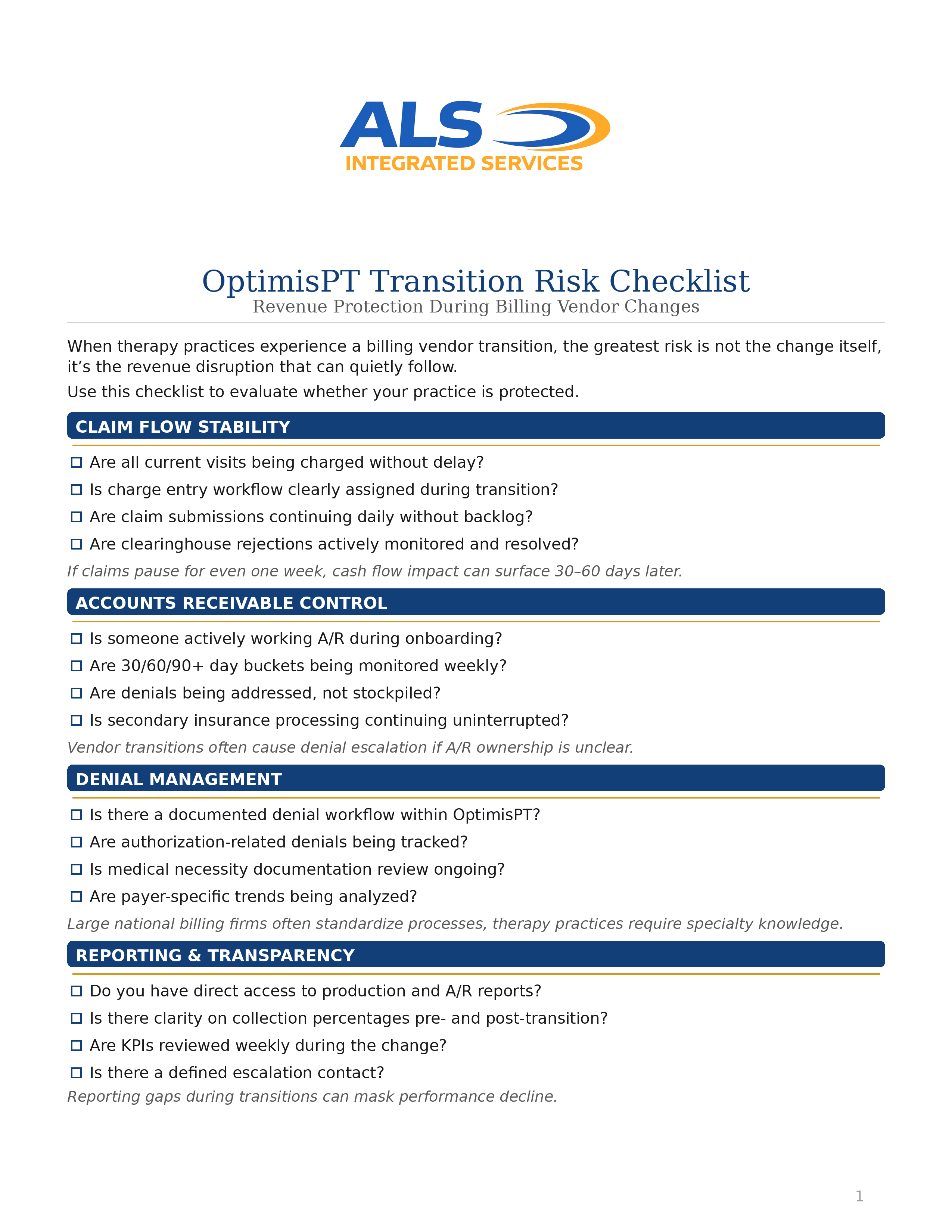
At ALS Integrated Services, we use a proven framework to ensure your transition is seamless. We focus on claim flow stability and accounts receivable control so you don't lose a beat. If you are using OptimisPT or a similar platform, we have specific checklists to ensure your revenue remains protected during the switch.
Take Control of Your Revenue Cycle
Your EMR is a tool for documentation and scheduling. It is excellent at being a digital filing cabinet. But just because a cabinet comes with a lock doesn't mean it knows how to manage your investments.
Don't let the convenience of "integrated" billing blind you to the fact that you might be losing 5-10% of your gross revenue to poor denial management and a lack of personalized oversight. Whether you are a small clinic in rural Pennsylvania or a multi-site operation in Phoenix, your therapy billing solutions should be as specialized as the care you provide.

Ready for a Revenue Check-up?
If you’re tired of "automatic" systems that don't produce automatic results, let’s talk. We specialize in streamlining operations without burning out and finding the hidden leaks in your revenue cycle.
Contact ALS Integrated Services today for a confidential review of your current billing performance.

FAQ: EMR Billing vs. Private Billing
Q: Is integrated billing cheaper?
A: On paper, sometimes. The percentage might be lower, but if they only collect 90% of what is owed and a private specialist collects 98%, the "cheaper" option actually costs you significantly more in lost revenue.
Q: Will switching billing companies disrupt my clinic’s workflow?
A: With a proper transition plan, disruption is minimal. Most of the work happens in the background, ensuring that your current claims keep paying while the new system is established.
Q: Does ALS Integrated Services work with my specific EMR?
A: We work with many of the leading therapy EMRs. Our goal is to leverage your existing software while providing the expert human oversight that the software companies lack.
Q: Do you handle state-specific rules for PA, AZ, and CO?
A: Absolutely. We stay on top of state-specific Medicaid changes and regional payer policies to ensure your claims are compliant and paid on the first submission.