

As we move further into 2026, the landscape of healthcare is shifting beneath our feet. For physical therapy clinics and specialized medical practices, staying profitable requires more than just excellent patient care; it requires a deep understanding of the evolving reimbursement environment. While 2026 brought a modest 2.5% increase in the Medicare physician fee schedule, many providers are finding that this "raise" is more of a band-aid than a cure for the rising costs of doing business.
At ALS Integrated Services, we specialize in medical billing services designed to navigate these very complexities. Whether you are operating a clinic in Arizona, Pennsylvania, or Colorado, the pitfalls of 2026 Medicare rules can lead to significant revenue leaks if your team isn't prepared.
In this guide, we will break down the primary reimbursement pitfalls of 2026 and how your practice can maintain a steady cash flow despite shifting federal policies.
1. The "Modest Increase" Illusion
The 2.5% increase in the Medicare conversion factor sounds positive on paper, but it fails to account for the reality of inflation and operational costs. Since 2013, total operating costs per physician have risen by over 60%, while Medicare payments have remained nearly stagnant.
For many clinics, 2026 is the year where the "cost-to-care" gap becomes unsustainable. If your clinic is still relying on outdated billing processes, you are likely losing a percentage of every claim to small errors that you simply cannot afford anymore. This is why many practices are looking to outsource PT billing to professionals who can squeeze every cent out of the fee schedule.
2. The Medicare Advantage "Black Hole"
Perhaps the most significant pitfall of 2026 is the massive shift in Medicare Advantage (MA) plans. We’ve seen insurers retreat from over 300 counties nationwide. This means millions of beneficiaries have been forced to switch plans, often landing in programs with much narrower networks and stricter eligibility requirements.
Practices in states like Arizona and Colorado are seeing a surge in "denied without valid referral" claims. Unlike traditional Medicare, these MA denials often cannot be overturned through standard appeals if the administrative groundwork wasn't laid before the patient walked through the door.
The Prior Authorization Trap
In 2026, MA plans have doubled down on prior authorizations. Even if a service was covered in 2025, the new 2026 guidelines may require advanced documentation or downcoding that effectively reduces your yield. To combat this, your front desk must be more rigorous than ever. Our therapy billing simplified guide highlights exactly how to handle re-evaluations and daily sessions to satisfy these picky payers.

3. CMS Analytics and the "Payment Suspension" Risk
One of the more aggressive moves by CMS in 2026 is the increased use of AI-driven analytics to trigger payment suspensions. In the past, a freeze on payments was usually reserved for clear cases of fraud. Today, CMS uses "perceived billing anomalies" or documentation gaps to retroactively freeze payments.
If your billing patterns show a sudden spike in certain CPT codes, even if legitimate, the system may flag you for an audit. This is why having a robust audit trail is non-negotiable. At ALS Integrated Services, we ensure that every claim is backed by the necessary documentation, from the correct use of GP, GO, and GN modifiers to the exact timing of progress notes.
4. The Beginning-of-Year Deductible Reset
A recurring pitfall that hits clinics hard every spring is the deductible reset. In 2026, we are seeing a higher prevalence of high-deductible health plans (HDHPs) among Medicare Advantage beneficiaries.
When a patient’s deductible resets, your clinic effectively becomes a "collections agency" for the first few months of the year. If you aren't collecting co-pays and towards deductibles at the time of service, your A/R will balloon, and your cash flow will crater.
Pro-Tip for 2026: Implement a "Credit Card on File" policy and utilize automated eligibility verification. We’ve identified 7 eligibility verification mistakes that are currently killing clinic cash flow; fixing these is the fastest way to stabilize your revenue at the start of the year.
5. State-Specific Insights: AZ, PA, and CO
Medicare reimbursement isn't a monolith; it varies based on geographic practice cost indices (GPCI).
- Arizona: With a high concentration of retirees, AZ clinics are feeling the brunt of Medicare Advantage plan exits. If you are in Maricopa County, you need to be hyper-vigilant about checking the "effective date" on new insurance cards.
- Pennsylvania: The regulatory environment in PA remains strict regarding therapist-assistant supervision ratios. Billing for services provided by a PTA or OTA without the proper modifiers (CQ/CO) remains a top reason for recoupments in 2026.
- Colorado: CO clinics are seeing a push toward value-based care models. While traditional fee-for-service is still dominant, missing the mark on quality reporting (MIPS) can lead to a 9% penalty on your total Medicare reimbursement.
6. Avoiding the Documentation Gap
Insufficient documentation is the number one reason for claim denials and recoupments in 2026. CMS is no longer looking for "good enough" notes; they are looking for specific clinical justifications that match the billed CPT codes.
For physical therapy, this means your notes must clearly demonstrate the "skilled" nature of the service. If a note looks like a gym routine, it will be denied. Our team helps clinics win the denial war by training staff on how to flip a "no" into a "paid" claim through better initial documentation and strategic appeals.
7. Why Professional Medical Billing Services are No Longer Optional
In years past, a clinic might have been able to "get by" with a front desk person doing the billing in their spare time. In 2026, that is a recipe for financial disaster. The complexity of the 2026 Medicare landscape requires a dedicated team that stays updated on every policy shift, every modifier change, and every local coverage determination (LCD).
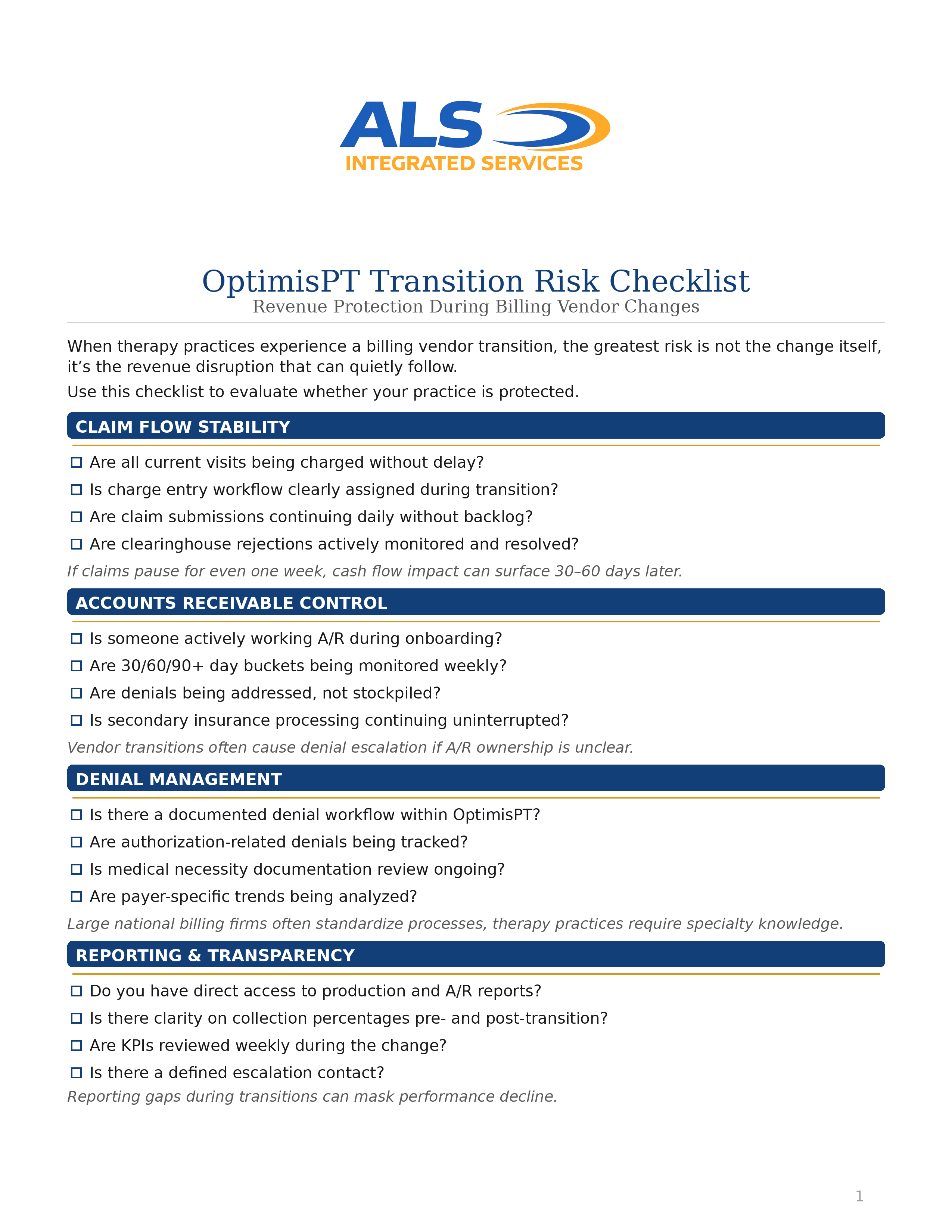
ALS Integrated Services provides medical billing services for physical therapy clinics that go beyond just submitting claims. We provide the revenue cycle oversight necessary to catch a $50,000 leak before it drains your practice. Our approach is built on a decade of experience with platforms like OptimisPT, ensuring a transition that is stable and transparent.
FAQ: Medicare 2026 Reimbursement
Q: What is the Medicare conversion factor for 2026?
A: The 2026 conversion factor reflects a 2.5% increase from 2025, but this is often offset by practice expense adjustments.
Q: Can I appeal a Medicare Advantage denial?
A: Yes, but in 2026, many MA plans have shortened the window for appeals and increased the requirements for clinical documentation to be submitted with the first-level appeal.
Q: Are there changes to the PTA/OTA 15% payment reduction?
A: The 15% reduction for services provided "in whole or in part" by an assistant remains in effect for 2026. Proper use of the CQ and CO modifiers is essential to avoid audit flags.
Protect Your Revenue in 2026
The pitfalls of Medicare 2026 are real, but they are manageable with the right partner. Don't let your hard work be undermined by administrative red tape or shifting payer rules.
If you’re feeling the pressure of increased denials or stagnant reimbursement, it’s time for a professional review of your revenue cycle. Contact ALS Integrated Services today for a confidential consultation on how we can streamline your physical therapy billing and secure your clinic's financial future.