Let’s pull back the curtain on a secret that most software companies don’t want you to know.
In the medical billing world of 2026, "automation" has become the ultimate buzzword. It’s sold as a magic wand that eliminates human error, slashes overhead, and guarantees a 99% clean claim rate. On paper, it looks like a dream. But behind the scenes, in the trenches of revenue cycle management, we are seeing a different story.
We are seeing clinics that believe they are running "lean and efficient" while their actual bank balances tell a much grimmer tale. As professional consultants at ALS Integrated Services, LLC, we see the fallout every day. The truth? Your "automated" software might be the very thing bleeding your practice dry.
Here is the confession: Automation without human oversight isn't a strategy: it’s a gamble. And in the current landscape, the house (the insurance companies) is winning.
The "Clean Claim" Lie: Why Your Dashboard is Deceiving You
Most modern billing platforms brag about their high "clean claim" rates. When you log in to your dashboard and see a 98% success rate, you feel a sense of peace. You think, "The software is doing its job."
But here is the insider secret: A "clean claim" only means the claim passed the software’s basic internal filters. It means the patient’s name is there, the NPI is valid, and the ICD-10 code exists. It does not mean the claim is going to get paid.
Software is excellent at catching typos, but it is notoriously bad at catching intent. It doesn’t know that a specific payer changed their policy on a specific modifier last Tuesday. It doesn’t notice that while the claim was "clean," it was actually under-coded, leaving $40 on the table for every single visit.

When you rely solely on touchless billing, you lose the "detective work" that a human expert provides. We’ve found that practices relying on 100% AI often have a climbing denial rate that is masked by these vanity metrics. If you’re seeing your denial rate climb despite your "perfect" software, you aren’t alone.
The 2026 Landscape: Payers Are Using AI to Reject You
It’s an arms race. While you are using automation to submit claims, insurance companies are using high-level AI to reject them. In 2026, payers have become surgical in their denial tactics. They aren't just looking for missing signatures; they are looking for patterns in treatment duration, frequency, and coding combinations that their algorithms flag as "inefficient."
An automated system submits the claim and waits. A human expert, however, notices the trend.
At ALS Integrated Services, LLC, we don’t just look at individual claims; we look at the "why" behind the "no." When we see a spike in denials from a specific payer in January 2026, we don't just resubmit. We investigate. Was it a January denial spike related to the Wiser Pilot? Is there a new documentation requirement that the software "scrubber" isn't programmed to see?
Without human oversight, these "silent denials" accumulate in your A/R for months until they are uncollectible. By then, the software has already moved on to the next "clean" (but doomed) claim.
The Deductible Reset Trap: Why Your Cash Flow Dies in Q1
Every year, like clockwork, January and February bring a cash flow crisis. Why? Because of the Great Deductible Reset. With high-deductible health plans (HDHPs) becoming the standard, many patients start the year owing 100% of their visit costs until they hit that $5,000 or $7,000 threshold.
Automated software is terrible at managing this. Most systems are programmed to:
- Submit the claim.
- Wait for the EOB/ERA.
- Post the "Patient Responsibility."
- Send an automated statement 30 days later.
By the time that automated statement hits the patient's inbox, they might be six visits deep into a plan they can’t afford. Your A/R balloons, and your "automated" system has no way of flagging the front desk to have a "real" conversation with the patient.
At ALS Integrated Services, LLC, we emphasize front desk training as part of our core consulting. We teach your team how to:
- ✓ Verify benefits before the first visit of the year.
- ✓ Communicate clear financial expectations regarding high deductibles.
- ✓ Collect "Estimated Patient Responsibility" at the time of service.
- ✓ Implement payment plans before the balance becomes a burden.
Automation can’t look a patient in the eye and explain why their physical therapy visit is costing them $150 out of pocket today. If your front desk isn't trained to handle these 2026 financial realities, you’re losing money that no "billing robot" can recover.
The "Bored Biller" Syndrome: When Experts Are Sidelined
We’ve seen it happen in the best clinics. You hire a talented biller: someone like "Rachel": who knows the ins and outs of the industry. Then, the clinic switches to an "all-in-one" automated platform. Suddenly, Rachel’s job is reduced to clicking "approve" on a screen.
She gets bored. She feels undervalued. More importantly, she stops looking for the nuances because the software tells her it’s already been "scrubbed."
This is where the danger lies. When your human experts stop engaging with the data because they trust the machine, the machine starts making expensive mistakes. When experts get bored, they leave. And when they leave, they take years of institutional knowledge with them.
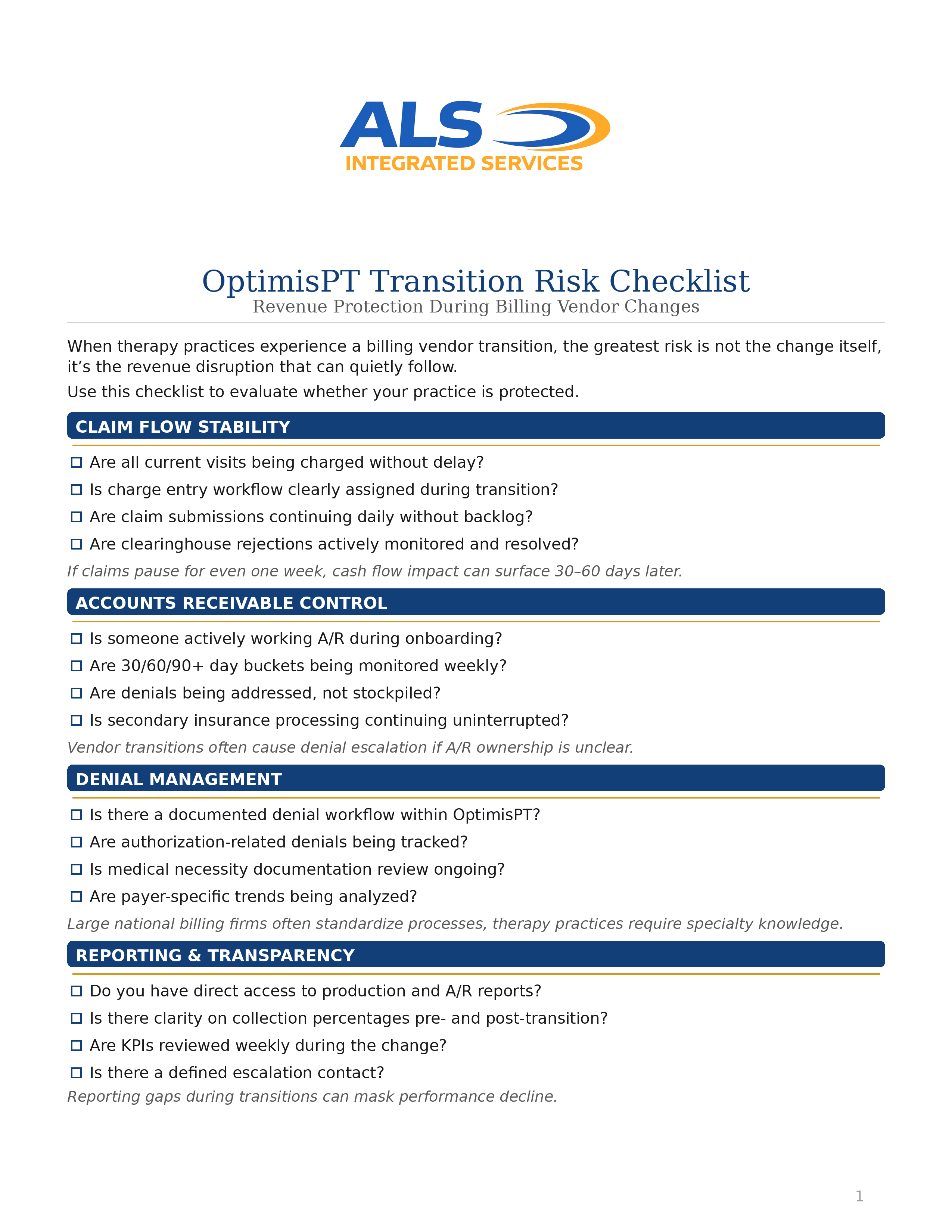
We believe in a hybrid approach. Use the technology to handle the repetitive tasks, but empower your human team to focus on high-level revenue cycle management. If you’re worried about the stability of your billing department during a transition, we even offer an OptimisPT Transition Risk Checklist to help you keep your revenue protected.
Why "Touchless" Often Means "Profitless"
The promise of "touchless" billing is that you don't have to think about it. But in 2026, if you aren't thinking about your billing, you aren't getting paid what you're worth.
Automated-only software fails in three critical areas:
- Credentialing Gaps: Software doesn't know if your new provider's credentialing is stuck in a "pending" queue. It will keep submitting claims that will eventually be denied as "provider not enrolled," creating a nightmare of re-filing.
- Uncollected Patient Balances: As we mentioned, software sends statements; it doesn't collect money. Without a human-driven process for patient collections, your "Bad Debt" write-offs will skyrocket.
- Missing Underpayments: If a payer is supposed to pay $95 for a code but starts paying $88, an automated system often just posts the payment. It doesn't scream "STOP" because technically, a payment was received. A human eye catches the $7 leakage that, over 1,000 visits, becomes a $7,000 loss.
The Solution: Human-Centric Revenue Cycle Management
We aren't saying you should go back to paper ledgers. Technology is a tool, but it is not the master. To succeed in the 2026 healthcare market, you need a partner that combines the speed of modern software with the analytical brain of a professional consultant.
At ALS Integrated Services, LLC, we provide that oversight. We act as the "checks and balances" for your automated systems. Our Insights section is filled with strategies on how to balance technology with human expertise to ensure you aren't leaving money on the table.
Our 5-Step Revenue Protection Plan:
- ✓ Weekly Trend Analysis: We look for denial patterns that software misses.
- ✓ Front Desk Empowerment: We train your team to handle the "deductible conversation" with confidence.
- ✓ Aggressive Denial Management: We don't just resubmit; we appeal with clinical evidence.
- ✓ Patient Balance Strategy: We move away from passive statements and toward proactive collections.
- ✓ Transparent Reporting: No vanity metrics. Just the cold, hard facts about your cash flow.
FAQ: Is My Software Actually the Problem?
Q: My software says my A/R over 90 days is low. Does that mean I'm okay?
A: Not necessarily. Some software "cleans" the A/R by automatically moving unpaid claims to "patient responsibility" or writing them off based on pre-set rules. You might be losing money without even knowing it.
Q: Should I fire my biller and just use the software's "Auto-Post" feature?
A: Absolutely not. Auto-posting is where many underpayments go to die. You need a human to verify that what was paid matches your contracted rates.
Q: How do I know if I'm a victim of the "Touchless Trap"?
A: Look at your total collections vs. your expected revenue. If your patient volume is up but your bank balance is stagnant, your automation is likely failing you. You can check our guide on The Real Cost of Doing Your Own Billing for more red flags.
Take Control of Your Revenue Today
Don't let a "set it and forget it" mentality ruin your practice's financial health. You’ve worked too hard to build your clinic to let a software algorithm bleed you dry.
Whether you need a full billing overhaul or a confidential review of your current processes, we are here to help. Let’s get your experts back in the driver’s seat and turn your billing department back into a profit center.
Contact ALS Integrated Services, LLC today for a confidential consultation.

Phone: [Insert Phone Number]
Web: alsintegratedsvc.com
Explore More: Insights & Strategies
Get in Touch: Contact Us
Stop settling for "clean claims" and start demanding actual revenue.